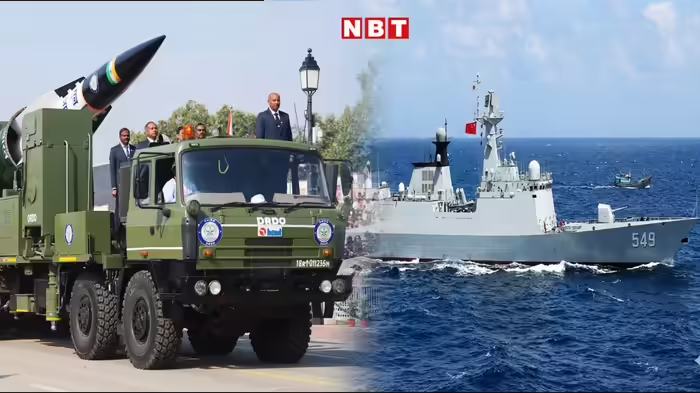
New Delhi/Islamabad/Beijing: India has unveiled its long-range hypersonic anti-ship missile, signaling a major shift in its maritime strategy. With China and Pakistan increasingly seeking to assert dominance in the Indian Ocean, this cutting-edge missile strengthens India’s ability to safeguard its strategic interests.
The missile, developed by India’s Defence Research and Development Organisation (DRDO), is designed to neutralize high-value targets such as aircraft carriers and warships at a range of 1,500 km. What sets this weapon apart is its unprecedented speed and maneuverability. Equipped with a two-stage solid propulsion system, the missile can reach speeds of Mach 10 and maintain an average of Mach 5 along a quasi-ballistic trajectory. Its ability to fly at extremely low altitudes makes it exceedingly difficult for radar and air defense systems to detect or intercept.
Strategic Impact on China’s ‘String of Pearls’
China has been developing its so-called ‘String of Pearls’—a network of ports and naval facilities across India’s neighboring countries, including Gwadar in Pakistan, Hambantota in Sri Lanka, and ports in Myanmar—to project power into the Indian Ocean. India’s hypersonic missile directly challenges this strategy.
This new missile places India among the select few countries, alongside the United States, Russia, and China, to possess a long-range hypersonic anti-ship system. It is expected to enter full operational service within the next 2–3 years and can be launched from either fixed or mobile platforms. Reports suggest deployment from India’s Andaman Islands, providing coverage over the Malacca Strait—a critical maritime chokepoint for Chinese oil shipments and naval movements. At a distance of just 150 km from the Malacca Strait, the missile significantly enhances India’s ability to target and neutralize high-value adversary vessels.
Ensuring Security of the Indian Ocean
The Indian Ocean is a strategic lifeline for global trade, including India’s. Over the past few years, China has supplied Pakistan with submarines and warships, raising the risk of disruption to India’s sea lines of communication (SLOCs). India’s hypersonic missile is designed to counter such threats, particularly against aircraft carriers and other major naval assets.
According to the 2024 U.S. Department of Defense China Military Power Report (CMPR), China’s navy was rapidly expanding, with over 370 ships and submarines in service by 2024. The April 2025 U.S. Congress Research Service report noted that China’s fleet had grown to 395 vessels, projected to reach 435 by 2030. In comparison, India’s naval expansion is modest, with approximately 150 warships currently, expected to rise to 230 by 2027. The hypersonic missile thus becomes a vital force multiplier for India’s maritime capabilities.
Expert Analysis
Geopolitical analyst Darshana Barua of the International Institute for Strategic Studies (IISS) wrote in May 2025 that China has conducted numerous naval exercises in the Indian Ocean and invested heavily in dual-use infrastructure projects in neighboring countries. While these serve economic purposes, they can also be leveraged for military advantage. India’s hypersonic anti-ship missile enhances its deterrence and operational reach in the region.
With this advanced weapon, India not only strengthens its maritime security but also signals a significant shift in the balance of power in the Indian Ocean, potentially disrupting China’s strategic ambitions in the region.
Discover more from SD NEWS agency
Subscribe to get the latest posts sent to your email.