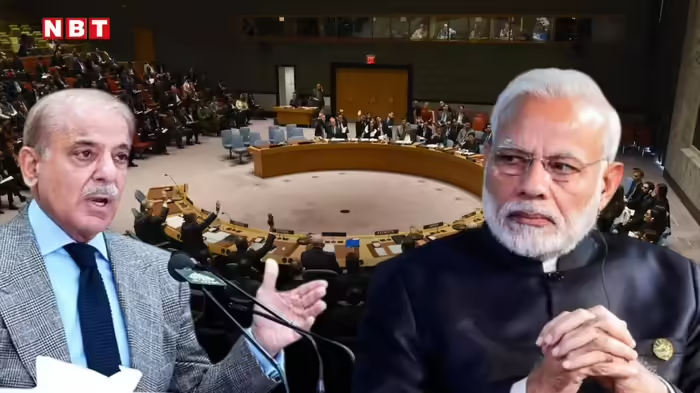
Munich: India continues to push for reform of the (UNSC), whose structure still reflects the post-World War II global order. Meanwhile, Pakistan opposes India’s proposed reforms, forming a counter-group known as the “Coffee Club.”
G4 Meeting in Munich
Last week, , India’s Foreign Minister, participated in a key G4 meeting in Munich. The gathering, held alongside the Munich Security Conference 2026, focused on UNSC reform. Jaishankar posted photos of the meeting with counterparts from , , and on social media, emphasizing the need for the UN to remain relevant amid rising global instability.
According to the Japanese Foreign Ministry, the 50-minute session included and focused on achieving concrete outcomes during the ongoing UN General Assembly session, working with current permanent members and African nations.
Why UNSC Reform Matters
The Security Council still mirrors the post-World War II order, but global power dynamics have shifted. Key points include:
Population and Representation: Countries like India and Brazil, with large populations, still lack permanent seats.
Regional Imbalance: East Asia, South America, and Africa have limited or no permanent representation.
Economic and Military Clout: Germany, India, and Japan rank among the world’s top five economies, and India and Japan are among the top military powers. India contributes more peacekeepers to UN missions than all five current permanent members combined, yet lacks permanent representation.
The G4 Alliance
The G4—comprising India, Brazil, Germany, and Japan—supports mutual efforts for permanent membership and broader UNSC reforms. Typically, the G4 meets annually during the UN General Assembly, but this was its first gathering alongside the Munich Security Conference.
Pakistan’s Coffee Club
India’s G4 unity has prompted discomfort in Pakistan, which has organized an informal counter-group called the Coffee Club, including countries like Italy, Canada, and South Korea. Pakistan advocates a model that increases representation for the Global South without adding new permanent members. Islamabad argues that the G4’s reforms serve the interests of a select few rather than offering equitable solutions, presenting a significant obstacle to UNSC reform.
Discover more from SD NEWS agency
Subscribe to get the latest posts sent to your email.