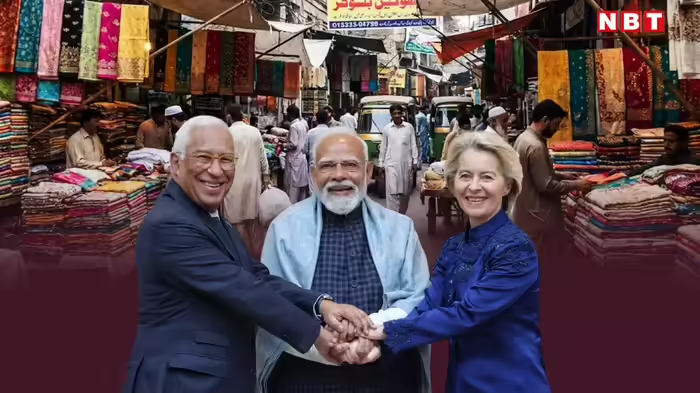
Islamabad/New Delhi: Pakistan is facing mounting economic anxiety following the finalisation of a historic Free Trade Agreement (FTA) between India and the European Union, a deal that European Commission President Ursula von der Leyen has described as the “mother of all trade deals.” Analysts and Pakistani media have warned that the agreement could significantly weaken Pakistan’s foothold in European markets and deepen its already fragile economic situation.
According to a report published by Pakistan-based news portal brief.pk, the India–EU trade pact poses a serious and immediate threat to Pakistan’s export-driven sectors, particularly textiles, and calls for urgent, pragmatic policy responses from the Shehbaz Sharif-led government rather than political rhetoric.
Preferential Access Shifts in India’s Favour
The report notes that the FTA will fundamentally reshape European markets by granting Indian products tariff advantages unmatched by any other EU trading partner. This, in turn, is expected to erode Pakistan’s benefits under the EU’s GSP Plus status, which has so far provided preferential access for Pakistani exports.
By 2032, EU exports to India are projected to double, while Indian exports to Europe are also expected to rise sharply across multiple sectors. In contrast, Pakistan—already struggling with dwindling foreign exchange reserves—risks losing market share it had managed to secure over the past decade.
Stark Trade Imbalance Highlights the Risk
The scale of the challenge is evident in trade figures. In FY 2024–25, India–EU bilateral trade reached approximately $136.5 billion, dwarfing Pakistan’s exports to the EU, which stand at around $9 billion. With India’s superior manufacturing capacity, supply-chain efficiency, and production scale, the report warns that Pakistan will find it increasingly difficult to compete on price, volume, or reliability.
Textile Sector Faces the Biggest Blow
Pakistan’s textile industry, which accounts for over 75% of its shipments to the EU, is expected to bear the brunt of the impact. Since receiving GSP Plus status in 2014, Pakistan’s textile exports to Europe have grown by 66.6%, pushing total exports from about $4.7 billion to nearly $9 billion.
However, India exported $7.01 billion worth of textiles, apparel, and home textiles to the EU in 2024, including $4.46 billion in ready-made garments, despite holding only about 3% of the EU’s total textile and apparel imports. With tariffs eliminated under the FTA, Indian exporters are expected to gain rapidly on the strength of competitive pricing, quality, design innovation, regulatory compliance, and faster delivery timelines.
The report estimates that Pakistan could lose more than 10% of its EU textile market share, translating into an annual revenue loss of $450 million to $900 million.
Agriculture and Leather Exports Also at Risk
Beyond textiles, Pakistan’s agriculture and leather sectors are also vulnerable. Pakistan exports grains, fruits, vegetables, fish, and leather goods to Europe. The India–EU agreement includes provisions for agricultural trade, and India’s vast farming base, coupled with stronger infrastructure and logistics, could easily sideline Pakistani exporters.
In the leather segment, where margins are already thin, tariff-free access for Indian exporters is likely to intensify price competition, placing further pressure on Pakistani manufacturers.
Strategic Implications Beyond Trade
The brief.pk analysis also underlines the strategic dimension of the agreement. Along with tariff concessions, the EU is offering India investment protection mechanisms and access to public procurement, encouraging European companies to expand operations and sourcing in India rather than neighbouring countries like Pakistan.
The EU increasingly views India as a key democratic partner in the Indo-Pacific and a stabilising force in a multipolar world. This strategic alignment, the report argues, further strengthens India’s economic influence while marginalising Pakistan in European trade and investment flows.
Warning to Islamabad
The report concludes with a stark warning: unless Pakistan negotiates a comparable trade arrangement with the EU and undertakes serious structural reforms, the risk of being pushed out of European markets altogether is rapidly increasing—an outcome that could have severe consequences for employment, exports, and economic stability.
Discover more from SD NEWS agency
Subscribe to get the latest posts sent to your email.