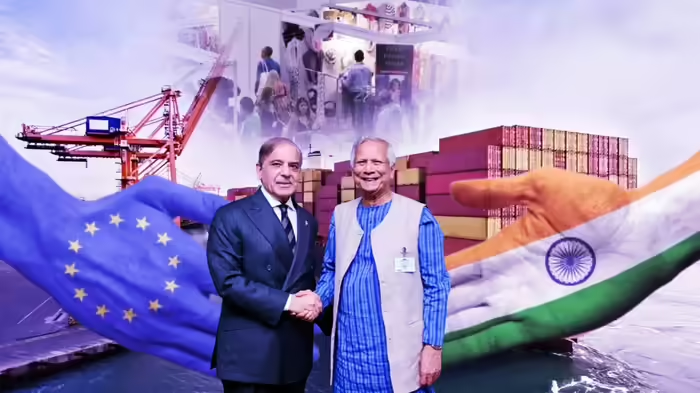
The recently signed India-European Union Free Trade Agreement (FTA) has triggered concerns in Pakistan and Bangladesh, as it promises to significantly reshape the European market for South Asian exports.
Immediate Reactions
Bangladesh’s interim government advisor, Mohammad Yunus, has urged the EU to expedite trade agreements with Dhaka. He met with the EU Ambassador to Bangladesh, Michael Miller, and Nuria Lopez, Chairperson of EuroCham Bangladesh, to discuss the implications of the new deal.
Meanwhile, Pakistani trade experts have warned Prime Minister Shehbaz Sharif’s government that delays in securing European trade deals could severely impact the country’s textile industry.
What Changes for Pakistan and Bangladesh?
Under decades-long arrangements, Pakistan and Bangladesh enjoyed preferential access to European markets. Pakistan benefited from the EU’s Generalized Scheme of Preferences (GSP), while Bangladesh leveraged the Everything But Arms (EBA) arrangement, which allowed its garments to enter Europe duty-free. These arrangements were crucial for both nations’ exports, particularly in textiles, which form a significant portion of foreign earnings.
However, under the new India-EU FTA, Indian goods will now enjoy zero-tariff access in Europe, eliminating the historical advantage of Pakistan and Bangladesh. Analysts predict that this could disrupt trade flows and intensify competition in the European market.
Trade Relations Overview
Pakistan: Since 2004, the EU has progressively granted Pakistan trade preferences, culminating in GSP Plus status in 2014. As a result, around 85% of Pakistani exports entered Europe duty-free, with the EU accounting for 12.4% of Pakistan’s total trade in 2024.
Bangladesh: Classified as a Least Developed Country (LDC), Bangladesh has enjoyed EBA privileges since 1975, with zero tariffs on all goods except arms and ammunition. In 2024, the EU was Bangladesh’s largest trading partner, with bilateral trade totaling £22.2 billion, mostly textiles.
Impact of the India-EU FTA
Before the FTA, Indian products faced Most Favoured Nation (MFN) tariffs—approximately 12% on textiles and 26% on seafood—making them costlier than comparable Pakistani and Bangladeshi goods in Europe. With the FTA, 90% of Indian exports, including textiles, garments, footwear, jewelry, and leather goods, will enter the EU duty-free.
India’s superior supply chain and scale mean that Pakistani and Bangladeshi exporters will face tough competition. Without new trade agreements or incentives, both nations risk losing their longstanding market advantages in Europe.
Economic Outlook
Despite previous tariff disadvantages, India-EU trade has grown 90% over the last decade, making the EU India’s largest trading partner in 2024, with bilateral trade of £120 billion. The FTA is expected to further boost Indian exports, strengthening its position in the European market and challenging neighboring countries’ share.