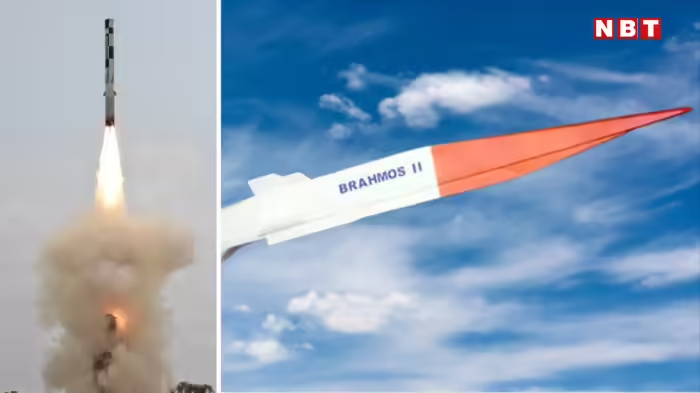
India and Russia are jointly working on a hypersonic upgrade of the BrahMos cruise missile, a move that could significantly alter the strategic balance in Asia and pose a serious challenge to China’s air defence and missile deterrence systems.
The announcement was made by Alexander Leonov, Director General and Chief Designer of Russia’s leading hypersonic missile manufacturer NPO Mashinostroyenia, who confirmed that efforts are underway to enhance the speed and performance of the BrahMos missile system, currently classified as a supersonic weapon.
“We are continuously modernising these missile systems and improving their performance. Under the BrahMos project, work is ongoing on compact missiles and hypersonic weapons,” Leonov said in Moscow, according to Russia’s state news agency Sputnik.
From Supersonic to Hypersonic: The BrahMos-2 Project
The hypersonic version of the missile, widely referred to as BrahMos-2, is expected to achieve speeds between Mach 5 and Mach 7, a significant leap from the existing BrahMos missile, which already travels at Mach 2.8 and is considered extremely difficult to intercept.
If successful, BrahMos-2 would become one of the fastest and most lethal cruise missiles in the world, capable of evading current and near-future air defence systems.
Former BrahMos Aerospace Director and senior DRDO scientist Atul Dinkar Rane recently stated that even the current BrahMos missile cannot be reliably intercepted by any air defence system for at least the next 5–7 years, confirming that the hypersonic development programme is actively underway.
Advanced Scramjet Technology and Extended Range
According to defence sources, BrahMos-2 is likely to be powered by a scramjet (supersonic combustion ramjet) engine, an advanced air-breathing propulsion technology that allows missiles to sustain hypersonic speeds over long distances.
The joint venture aims to develop a missile with a strike range of up to 1,500 kilometres, significantly expanding India’s deep-strike capability across land and maritime domains.
The programme involves cutting-edge technologies, including:
- High-temperature resistant materials
- Advanced aerodynamics
- Precision guidance and control systems
- Sustained hypersonic propulsion
These technologies are considered among the most complex in modern weapons development and require continuous testing and upgrades.
Russia’s Hypersonic Expertise, India’s Strategic Gain
Russia brings extensive experience to the programme, having successfully developed systems such as the Zircon hypersonic missile, Oniks cruise missile, and the Bastion coastal defence system. NPO Mashinostroyenia also manages operational readiness of strategic ballistic missiles and designs advanced radar satellites.
India is expected to leverage this expertise to accelerate its own hypersonic weapons capabilities, a domain currently dominated by a few global powers.
Defence analysts estimate that integration of BrahMos-2 across the Indian Army, Navy, and Air Force could begin around 2031, once developmental and testing milestones are achieved.
Strategic Implications for China
The development of BrahMos-2 carries significant implications for China’s Western Theatre Command and Rocket Force. While Beijing is actively working on air defence systems to counter existing BrahMos variants, a successful hypersonic version would render such defences ineffective for several years.
Military targets across Tibet and western China would fall within the missile’s strike envelope, providing India with a potent counter to China’s growing missile and air defence network.
Experts describe BrahMos-2 as a potential game-changer in the Indo-Pacific strategic environment, strengthening India’s deterrence posture and narrowing China’s technological advantage in hypersonic warfare.
Discover more from SD NEWS agency
Subscribe to get the latest posts sent to your email.