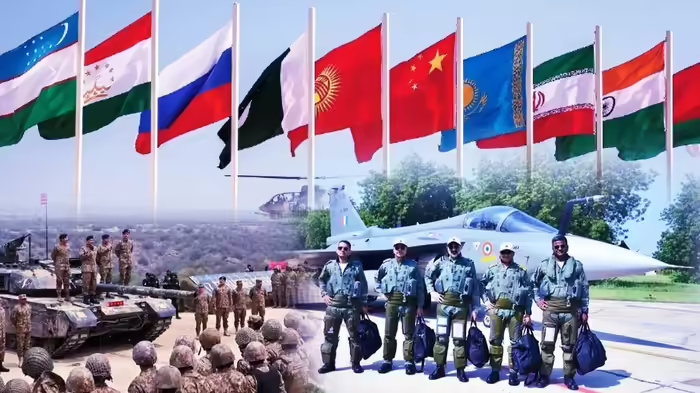
Tehran: India and Pakistan—two nations with a long history of hostility, military conflicts, and diplomatic friction—have come together on the same platform for a joint military exercise in Iran. Despite deep tensions and the sharp escalation following a four-day border clash in May this year, their armed forces participated side by side in a counterterrorism drill under the Shanghai Cooperation Organisation (SCO).
The 2025 SCO-led counterterrorism exercise was held in Sahand, Iran. Both Indian and Pakistani contingents trained on the same ground, though experts caution against interpreting this as a sign of improving bilateral relations. They describe it instead as an “institutional obligation” that both nations, as SCO members, are required to fulfill.
The Exercise in Iran
The joint counterterrorism drill began on 1 December in Iran’s East Azerbaijan province and concluded on Friday, 5 December. All 10 SCO member nations—Iran, China, Russia, India, Pakistan, Kazakhstan, Kyrgyzstan, Tajikistan, Uzbekistan, and Belarus—participated in the exercise.
Launched in 2003, SCO counterterrorism drills aim to strengthen regional cooperation against terrorism. India and Pakistan joined the SCO in 2017 and have since participated in such exercises to improve operational coordination, intelligence sharing, and response capabilities.
A Calendar Compulsion, Not Diplomatic Progress
According to TRT, former Pakistani diplomat Asif Durrani said that both countries are bound by SCO commitments and cannot opt out of such activities. Considering current tensions, he added, the likelihood of meaningful bilateral dialogue during the exercise remains extremely low.
JNU professor Swaran Singh noted that these drills offer a rare opportunity for Indian and Pakistani forces to observe and understand each other. Since terrorism remains a core issue in India-Pakistan tensions, he said, the exercises hold operational relevance even if they do not influence diplomacy.
India’s Strategic Calculus
Indian strategic experts emphasize that New Delhi’s participation is driven not by the need to engage Pakistan but by broader regional interests. The exercises allow India to maintain continuity in counterterrorism cooperation and gain exposure to military practices across the region.
Singh added that the drill also helps India deepen its strategic engagement with Iran, a long-standing partner. He stressed that India and Pakistan have taken part in similar SCO activities in the past, and this instance is not unprecedented.
Can SCO Reduce Mistrust?
Analysts on both sides agree that while SCO provides a platform where India and Pakistan can appear together, it cannot replace direct diplomacy. Nor is it expected to significantly improve bilateral relations. The presence of both militaries in a joint setting is symbolic, yet insufficient to resolve deep-rooted distrust.
Discover more from SD NEWS agency
Subscribe to get the latest posts sent to your email.