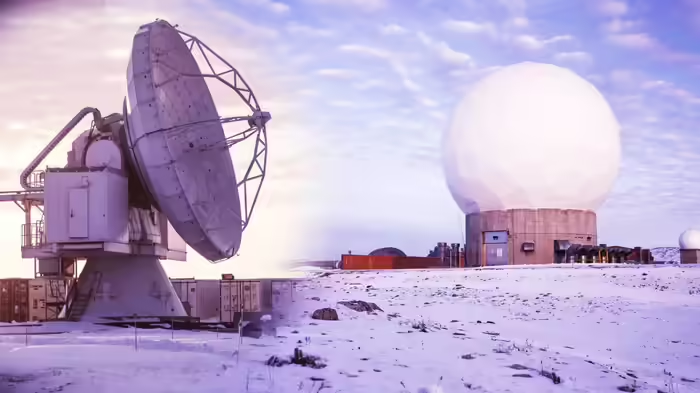
Greenland: U.S. President Donald Trump’s insistence on controlling Greenland has once again put the Arctic island at the center of global debate. Beyond the headlines, Greenland houses the Pitufic Space Base, America’s northernmost military installation, which plays a critical role in satellite tracking and missile defense, effectively shielding against potential attacks from space.
From Thule to Pitufic: A Strategic Evolution
Originally known as Thule Air Base, the facility is the only U.S. military installation in Greenland, located 750 miles north of the Arctic Circle. The base features advanced radar and satellite systems that provide early missile warning and space domain awareness, making it a vital node in America’s defense against orbital threats.
Its location along Greenland’s northwest coast offers unmatched oversight of northern air and space routes, allowing the U.S. to monitor Arctic security risks, track rival activities, and observe new maritime routes emerging due to climate change.
A Legacy of Strategic Importance
The U.S. presence in Greenland dates back to World War II, with Pitufic originally built in 1951 as a secret Cold War bomber base. It was designed to refuel long-range American bombers en route to the Soviet Union, symbolizing decades of frontline strategic utility.
In 2023, the base was renamed Pitufic Space Base to better reflect its modern role in space operations, moving beyond Cold War-era associations while honoring Greenland’s cultural heritage. Today, it houses the 12th Space Warning Squadron, operating ballistic missile early warning radars, alongside a satellite tracking team supporting global space operations. Despite extreme conditions—nine months of snow cover and three months of total darkness—the base operates year-round.
Growing Arctic Geopolitics
With Russian and Chinese activity increasing in the Arctic, Pitufic’s significance has expanded. The base serves as a key monitoring point for both U.S. and NATO operations, hosting 150 American personnel alongside Danish and Greenlandic staff. Its operations are governed by the 1951 defense agreement between the U.S. and Denmark, which allows the U.S. to maintain installations while recognizing Greenlandic sovereignty. Any expansion or changes require consultation with both the Danish and Greenlandic authorities.
In short, Greenland is more than an icy frontier—it is a strategic shield in the Arctic, pivotal for U.S. space defense, missile tracking, and geopolitical oversight in a region growing increasingly contested.
Discover more from SD NEWS agency
Subscribe to get the latest posts sent to your email.