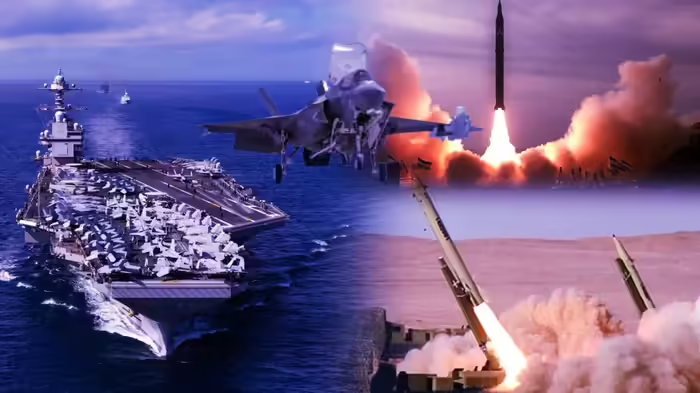
Amid rising tensions between the United States and Iran, the U.S. Navy’s aircraft carrier USS Abraham Lincoln has arrived in the Middle East, a move confirmed by U.S. Central Command. The deployment has fueled speculation that President Donald Trump could authorize military action against Iran at any moment. Tehran, however, has warned that any attack would be met with a swift and powerful response.
While Iran cannot match the United States in terms of overall military power, it has invested heavily over the past decades in building a formidable missile arsenal—one of the largest in the Middle East.
Iran’s Missile Advantage
Iran is estimated to possess over 3,000 missiles, including precision-guided systems such as the Fateh‑110, designed to strike naval targets operating in narrow waterways like the Strait of Hormuz. Tehran’s core strategy against the U.S. Navy relies on overwhelming force rather than direct confrontation.
Military analysts say Iran’s most dangerous tactic would be a mass saturation attack—launching hundreds of missiles, rockets, and drones simultaneously to overload U.S. naval radar and air-defense systems.
Iran reportedly demonstrated this capability in June 2025, during clashes with Israel, when it fired large numbers of missiles that overwhelmed Israel’s Iron Dome and Arrow‑3 defense systems. Several missiles penetrated Israeli defenses, causing significant damage.
Vulnerabilities of a Carrier Strike Group
The USS Abraham Lincoln is protected by Arleigh Burke‑class destroyers, each equipped with 90–98 vertical launch cells carrying interceptor missiles. However, experts warn that if the number of incoming threats exceeds available interceptors, the fleet could face a critical ammunition shortage during prolonged attacks.
America’s Layered Defense Shield
The U.S. Navy relies on the Aegis Combat System, powered by SPY‑1 radar, capable of tracking and engaging more than 100 targets simultaneously. Long-range threats are countered using Standard Missile‑6 (SM‑6) interceptors, which can destroy targets up to 240 kilometers away.
If missiles penetrate this outer layer, ships deploy Evolved Sea Sparrow Missiles (ESSM) as a mid-range defense. Each launch cell can hold four ESSMs, allowing higher interception density.
As a last line of defense, the Phalanx Close‑In Weapon System (CIWS) activates automatically. This radar‑guided system fires up to 4,500 rounds per minute, designed to neutralize incoming missiles at extremely close range.
A High-Risk Standoff
While U.S. aircraft carriers remain among the most heavily defended military assets in the world, analysts caution that no system is invulnerable to large‑scale saturation attacks. A direct clash would carry enormous risks for both sides and could rapidly escalate into a wider regional conflict.
The arrival of the USS Abraham Lincoln signals deterrence—but it also highlights how modern missile warfare has narrowed the margin of safety, even for the world’s most powerful navy.
Discover more from SD NEWS agency
Subscribe to get the latest posts sent to your email.