Naypyidaw/New Delhi.
A fierce geopolitical contest is erupting in India’s neighbourhood over some of the world’s most valuable rare-earth minerals. As U.S.–China rivalry deepens, Myanmar—already fractured by a violent civil war—has emerged as the latest arena where global powers are scrambling for strategic control. Located at the tri-junction of India, China and Southeast Asia, the mineral-rich nation has now drawn the attention of the QUAD nations: India, the United States, Australia and Japan.
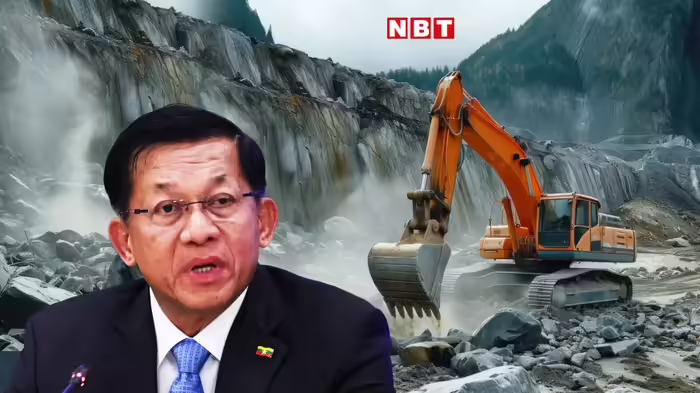
With the world’s third-largest rare-earth deposits—especially Dysprosium, a mineral critical for precision-guided weapons, electric vehicles and high-end electronics—Myanmar has become a prize no major power wants to lose. Whoever secures control over these minerals gains leverage over advanced weapon manufacturing, future electronics supply chains, and long-term global dominance.
China’s Grip Faces Resistance—QUAD Enters the Picture
Since Myanmar’s 2021 military coup, China has entrenched itself deeply by supplying weapons and offering diplomatic cover to the junta. Western sanctions further pushed the Myanmar military into Beijing’s arms. China quickly captured over 80% of Myanmar’s strategic mineral exports, transferring unprocessed minerals directly to Chinese refining units.
But the equation is changing rapidly.
Ethnic armed groups like the Kachin Independence Army (KIA) have gained ground against the junta, making it harder for Beijing to maintain unhindered access to rare-earth mining zones. KIA has blocked Chinese operations across several key sites—opening the door for new players.
The United States has seized the opportunity.
According to intelligence assessments, the Trump administration has reopened channels with Myanmar’s military, offering limited relief measures. Meanwhile, U.S. intelligence networks have become increasingly active through the Chiang Mai Consulate in northern Thailand. Though Washington’s path remains fraught, China’s once unchallenged dominance is now facing its first major cracks.
India Emerges as a Key Power Player
For Washington, penetrating Myanmar’s complex political and tribal landscape is impossible without New Delhi’s partnership. India, sharing a long land border and deep cultural links with Myanmar, has quietly positioned itself at the center of the rare-earth equation.
At the heart of India’s strategy is the National Critical Mineral Mission 2025, a blueprint to secure foreign mineral assets, build advanced processing zones and strengthen R&D capabilities. India’s state-run KABIL is already surveying resources in Argentina and Australia—and Myanmar could become the next strategic frontier.
New Delhi has intensified consultations with Myanmar’s ministries and geological departments, exploring collaboration in the Kachin region—the same zone where China’s operations are faltering. QUAD partners Australia and Japan are pushing for northeast India to emerge as an alternative rare-earth processing hub, reducing the world’s dependence on China.
India’s proximity, evolving extraction technologies, and diplomatic access give it a decisive advantage—positioning New Delhi as a regional power broker in the unfolding mineral war.
A New Geo-Political Warzone Next Door
As global powers manoeuvre to secure the minerals that will shape future technology and defence systems, Myanmar is set to remain the geopolitical battleground for years to come. With China, the U.S., India and the QUAD all attempting to tip the balance, the struggle for control over one of the world’s most valuable resources has only just begun.
Discover more from SD NEWS agency
Subscribe to get the latest posts sent to your email.