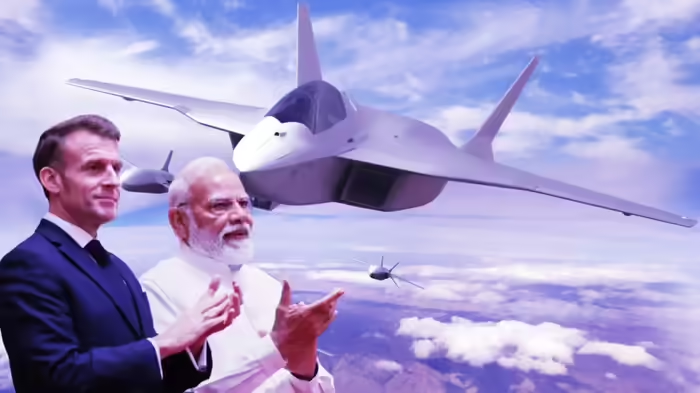
Paris: India has intensified efforts to join Europe’s largest sixth-generation fighter jet program, the Future Combat Air System (FCAS), after Germany’s recent withdrawal. The program, launched in 2017 by France, Germany, and Spain with a budget of €100 billion, aims to develop an advanced stealth fighter capable of carrying nuclear weapons and launching from aircraft carriers.
Germany Pulls Out
Reports indicate that preliminary discussions have already taken place between India and France regarding potential participation. Germany’s exit, announced last week by Chancellor Friedrich Merz, opens the door for India. Germany cited fundamental differences with the program: while France requires a nuclear-capable fighter, Germany opposes nuclear weapons entirely and has even shut down its nuclear power plants.
Project at a Crossroads
The withdrawal of Germany threatens the cohesion of the FCAS program. Disagreements among key partners — Dassault Aviation (France), Airbus (Germany/Spain), and Indra Sistemas (Spain) — have prompted proposals for a two-fighter solution. Under this plan, France would develop one design, while Germany and Spain create another, linked via a shared combat cloud and drone system. Airbus CEO Guillaume Faury suggested this approach to ensure that the high-tech program’s future remains secure despite Germany’s departure.
India’s Potential Role
Sources cited by The Print reveal that India has expressed interest in joining FCAS in the absence of Germany. Already developing its own fifth-generation Advanced Medium Combat Aircraft, India sees participation in FCAS as an opportunity to accelerate access to sixth-generation fighter technology. While the India-France partnership in FCAS is still under discussion, New Delhi’s close monitoring of Europe’s largest air combat project indicates serious strategic intent.
Discover more from SD NEWS agency
Subscribe to get the latest posts sent to your email.