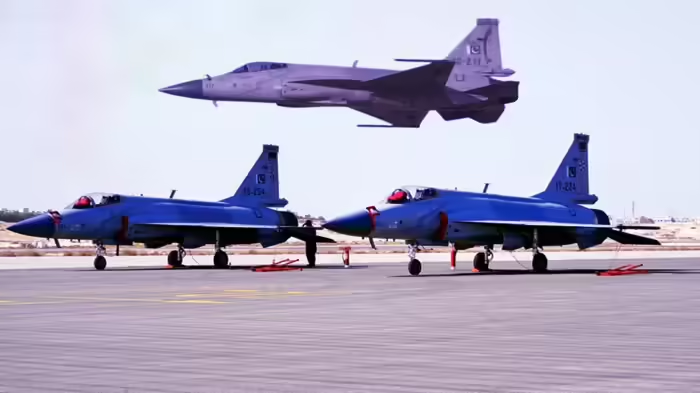
Islamabad: Pakistan has scored two major early wins in the global defence market this year, signalling its growing ambitions as an arms exporter. The Pakistan Army has indicated that a deal to sell JF‑17 Thunder fighter jets to Bangladesh is close to finalisation. At the same time, Saudi Arabia is reportedly considering the purchase of JF‑17 aircraft in a deal worth around $2 billion, partly linked to loans extended to Pakistan.
Beyond Bangladesh and Saudi Arabia, several other countries have already inducted the JF‑17 into their air forces, while many more are evaluating the jet. This rising interest has placed Pakistan’s flagship fighter aircraft firmly in the international spotlight and raised a key question: what makes the JF‑17 so attractive to so many countries?
Affordable, Capable and Sanctions-Free
According to Al Jazeera, one of the biggest reasons behind the JF‑17’s popularity is its competitive pricing. With an estimated cost of $25–30 million per aircraft, it is significantly cheaper than many Western alternatives. For developing and mid-sized nations looking to modernise their air forces without overstretching defence budgets, the JF‑17 offers a practical solution.
Equally important is its freedom from Western sanctions. Jointly developed by Pakistan Aeronautical Complex (PAC) and China’s Chengdu Aircraft Corporation (CAC), the aircraft is not subject to the political and export restrictions often attached to US or European fighter jets. This makes it particularly appealing to countries facing diplomatic pressure or arms embargoes.
Features and Capabilities
The JF‑17 Thunder is a lightweight, all-weather, multi-role combat aircraft designed for air-to-air, air-to-ground and reconnaissance missions. Production is split between Pakistan (58 per cent) and China (42 per cent), with final assembly carried out in Kamra, Punjab—making Pakistan the primary exporter.
Over the past decade, countries such as Myanmar, Nigeria and Azerbaijan have inducted the JF‑17 into their fleets. Myanmar was the first buyer, ordering at least 16 Block‑2 aircraft in 2015. Nigeria followed in 2021 with three jets, while Azerbaijan signed a $1.5 billion deal in 2024 for 16 aircraft and unveiled five of them in November 2025.
Several other nations—including Iraq, Sri Lanka and Saudi Arabia—have explored the option of acquiring the JF‑17, though not all discussions have yet translated into confirmed orders.
Where the JF‑17 Stands Globally
While the world’s most advanced combat aircraft belong to the fifth generation—such as the US F‑22 and F‑35, China’s J‑20 and J‑35, and Russia’s Su‑57—these jets are expensive and available to only a handful of countries.
The latest JF‑17 Block‑3 is considered a 4.5‑generation fighter, placing it in the same broad category as Sweden’s Gripen, France’s Rafale, the Eurofighter Typhoon, India’s Tejas and China’s J‑10. Aircraft in this class feature reduced radar signatures, advanced avionics and electronic warfare systems, allowing them to operate effectively even in contested airspace.
Defence experts note that while 4.5‑generation jets can still be detected by modern radars, their electronic jamming and countermeasure capabilities significantly complicate enemy tracking and targeting.
A Strategic Tool for Pakistan
For Pakistan, the JF‑17 is more than just a fighter jet—it is a strategic instrument to expand its diplomatic and economic footprint. As nations seek affordable, capable and politically flexible defence solutions, the JF‑17 Thunder is emerging as a strong contender in the global arms market, helping Islamabad project influence far beyond South Asia.
Discover more from SD NEWS agency
Subscribe to get the latest posts sent to your email.