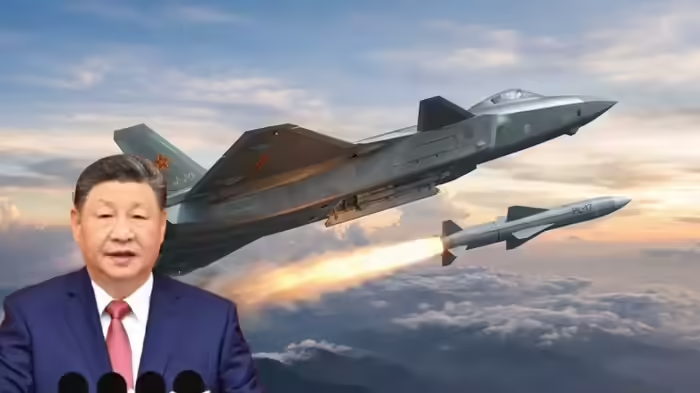
Beijing: China’s most secretive and feared air-to-air missile, the PL-17, has been seen up close for the first time, sparking intense discussion among global defence analysts. Believed to be the People’s Liberation Army Air Force (PLAAF)’s longest-range air-to-air missile, the PL-17 is considered significantly more dangerous than the widely known PL-15 missile due to its massive size, advanced guidance system, and an estimated range of nearly 400 kilometres.
The PL-17 is an air-to-air missile similar in role to the PL-15, but with far greater reach and strategic intent. While the missile has existed for years, China has never officially disclosed its specifications. Its sudden appearance in a close-up image has therefore attracted global attention—especially in the United States, which has reportedly accelerated production of long-range air-to-air missiles to counter China’s growing aerial threat.
What the New Image Reveals About PL-17
The newly surfaced image appears authentic, though its exact date and location remain unverified. The photograph shows a full-scale model of the PL-17 displayed on a stand, likely at a Chinese trade show or defence exhibition. A man is seen posing next to the missile, with his face blurred, while a promotional board for China’s J-20 stealth fighter jet is visible in the background.
Defence publication The War Zone reports that the missile’s appearance is surprising, given that the first blurred images of PL-17 surfaced nearly a decade ago. Until now, there has been almost no official or clear visual confirmation of the missile’s design.
How PL-17 Compares to PL-15
After the PL-15, which gained attention when Pakistan reportedly used it against India during post–Operation Sindoor hostilities, the PL-17 represents a major leap in China’s air combat capabilities.
- PL-15 range (Chinese version): Slightly over 200 km
- PL-15 export variant: Around 150 km
- PL-17 estimated range: Around 250 miles (400 km)
Early assessments suggest that the PL-17 is nearly 20 feet long, making it one of the largest air-to-air missiles ever developed. Its size indicates a specific role—targeting high-value aerial assets such as airborne early warning aircraft (AEW&C), air tankers, and surveillance platforms, rather than agile fighter jets.
Advanced Design and Performance
Reports suggest that the PL-17 is powered by a dual-pulse rocket motor, enabling sustained energy during long-range engagements. Control is believed to be achieved via four small tail fins and a thrust-vectoring nozzle. The missile’s top speed is estimated at Mach 4, though actual performance would vary depending on launch altitude and combat conditions.
In terms of guidance, the PL-17 is reportedly equipped with a two-way data link combined with an Active Electronically Scanned Array (AESA) seeker, making it highly resistant to electronic countermeasures. Some reports also indicate the presence of a passive anti-radiation seeker, enhancing its ability to home in on radar-emitting targets.
Integration With Chinese Fighter Jets
The PL-17 has previously been seen mounted on the J-16 fighter aircraft. It is now believed that China has integrated or plans to integrate the missile with its J-20 stealth fighter jet. However, due to its large size, the missile must be carried externally, which compromises the stealth characteristics of the J-20.
Because of its length, integrating the PL-17 into platforms such as the J-10C or J-35 stealth fighter is considered extremely difficult. This also makes the missile unlikely to be exported, including to Pakistan.
Strategic Implications for India and the Region
While the possibility of PL-17 being supplied to Pakistan appears minimal, defence experts caution against complacency. The missile is more likely being developed for future platforms such as China’s sixth-generation J-36 fighter jet, where its full range and capabilities could be exploited.
For India, the immediate threat of PL-17 deployment on the Pakistan front remains low. However, China’s rapid advancements in long-range air combat weaponry underline the need for continuous preparedness and technological upgrades.
Conclusion
The PL-17 represents China’s ambition to dominate the skies far beyond traditional air combat ranges. With its extreme reach, advanced guidance, and focus on high-value aerial targets, the missile could significantly alter future air warfare dynamics in the Indo-Pacific region.
Discover more from SD NEWS agency
Subscribe to get the latest posts sent to your email.