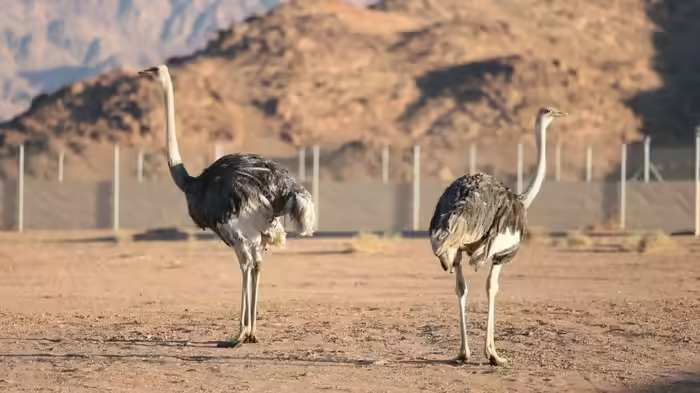
RIYADH: In a remarkable conservation milestone, the “Camel Bird,” scientifically known as the Arabian Ostrich, has returned to the Saudi desert after nearly a century. Once abundant across the region, this iconic bird had nearly vanished and was long considered extinct.
The Saudi Press Agency recently shared photographs of the red-necked ostriches released in the wild as part of the Kingdom’s ambitious Rewild Arabia Initiative. Historically, the bird was admired by Arab poets and Roman scholars alike, but over the past decades, its population dwindled drastically.
Now, under the Mohammed bin Salman Royal Reserve’s rewilding program, the red-necked ostrich has been reintroduced to Saudi Arabia. Serving as a biological replacement for the extinct Arabian (Syrian) Ostrich—which disappeared in the early 20th century due to hunting and habitat loss—this species is the closest genetic relative and well-adapted to survive in the desert’s harsh conditions.
Five Birds Released to Restore Ecosystem Balance
Five red-necked ostriches were released into the reserve with the aim of restoring historical biodiversity across the reserve’s 24,500 sq. km terrestrial and marine ecosystems. This species marks the 12th of 23 historically native species reintroduced as part of the reserve’s long-term ecological restoration strategy.
Andrew Zaloumis, CEO of the Mohammed bin Salman Royal Reserve, described the initiative as “symbolic and transformative.” He emphasized that bringing back such an iconic desert species after a century holds profound ecological and cultural significance. In 2024, the reserve achieved a similar success by reintroducing the Persian Onager after 100 years of absence.
Saudi Authorities Hopeful for Conservation Success
Zaloumis said the return of the ostrich adds to a growing list of conservation successes and signals the gradual restoration of Saudi Arabia’s desert ecosystems. The presence of both species—absent from the reserve for generations—also represents a revival of the Kingdom’s cultural heritage.
The initiative is carried out in partnership with the National Center for Wildlife and the Royal Reserve and aligns with Vision 2030 and the Saudi Green Initiative. These national frameworks aim to boost biodiversity, restore degraded ecosystems, and protect 30% of the Kingdom’s land and marine areas by 2030.
Discover more from SD NEWS agency
Subscribe to get the latest posts sent to your email.