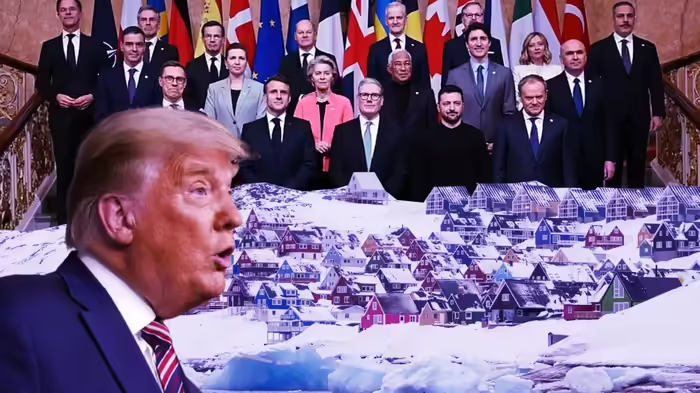
London: Once again, U.S. President Donald Trump has raised the stakes over Greenland, signaling a desire to bring the strategically located island under American control. This bold move has sent waves of concern across Europe, affecting not just Greenland and Denmark but NATO allies as a whole. Despite strong objections from Greenland and Copenhagen, Trump shows no sign of backing down.
Both Denmark and the United States are NATO members, meaning they are committed to collective defense. Yet, for the first time, NATO faces the extraordinary scenario of one member threatening another, raising questions about alliance cohesion. According to CNN, the White House has not ruled out the use of military options in Greenland, escalating tensions further.
European Leaders Caught in a Dilemma
Danish Prime Minister Mette Frederiksen warned that any U.S. attack on Denmark would spell the end of NATO. European leaders, though deeply concerned, are hesitant to confront the United States openly, particularly amid heightened tensions with Russia. The continent is struggling to balance deterring U.S. overreach while maintaining alliance unity.
This delicate tension was evident during a recent meeting in Paris, where representatives from 35 countries, including the U.S., discussed post-war security guarantees for Ukraine under a potential peace deal with Russia.
Hesitant Responses from NATO Capitals
UK Prime Minister Keir Starmer chose cautious language, emphasizing solidarity with Denmark without directly addressing Trump’s claims. French President Emmanuel Macron similarly avoided confrontation. Analysts, including Mujtaba Rahman, Managing Director at Eurasia Group Europe, note that while many European leaders want to challenge the U.S., they lack the strategic independence to do so. Rahman explained that Europe would take three to five years to rebuild significant military capabilities, leaving the continent dependent on U.S. goodwill in the short term.
Veteran American diplomat Daniel Fried emphasized Europe’s current reliance on U.S. military hardware and expressed concern that the continent fears Trump’s ire more than it fears any territorial compromise.
Potential Responses and Strategic Options
Some European voices, such as French MEP Raphael Glucksmann, suggest establishing a permanent EU military presence in Greenland to send a strong message to Washington. Others, like Mazda Rouz, Senior Policy Fellow at the European Council on Foreign Relations, argue that direct military confrontation with the U.S. should be avoided and that alternative diplomatic and strategic measures should be pursued. These debates highlight Europe’s unease over Greenland and the broader implications for NATO cohesion.
Why Greenland Matters
Greenland, home to around 57,000 people, is a strategically critical island with autonomous governance. While it has its own local Prime Minister, defense and foreign policy remain under Denmark’s control. Historically, Greenland has occasionally sought greater independence, but such aspirations do not imply alignment with the U.S. Public sentiment on the island shows resistance to American control, making Trump’s ambitions especially sensitive.
The Greenland issue underscores the fragility of NATO unity when national interests and strategic ambitions collide, leaving European leaders to weigh carefully between confronting Washington or compromising a key strategic asset.
Discover more from SD NEWS agency
Subscribe to get the latest posts sent to your email.