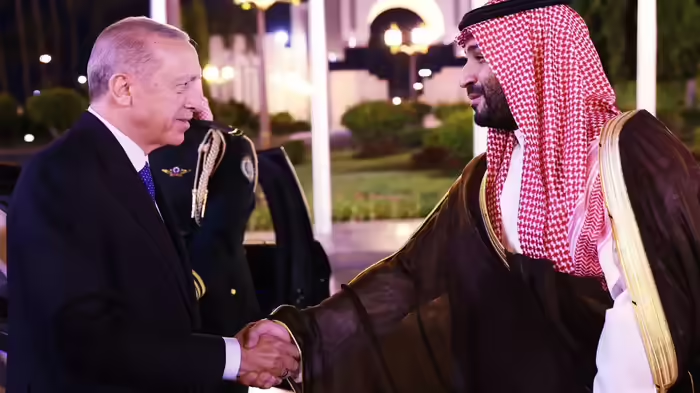
Riyadh & Cairo: Turkish President Recep Tayyip Erdoğan has embarked on a historic diplomatic tour of Saudi Arabia and Egypt, setting aside years of animosity to foster regional cooperation. This “grand reunion” with former adversaries signals the emergence of a potential Middle East super-alliance and reflects Ankara’s ambitions to assert greater influence in the Islamic world.
Meeting Saudi Leadership
Erdoğan arrived in Riyadh on Tuesday, where he met Crown Prince Mohammed bin Salman. The talks, widely publicized as the coming together of the two largest economies in the MENA region, focused on enhancing trade, regional security, and diplomatic collaboration. Analysts note that this meeting represents a major thaw in historically tense Turkey-Saudi relations.
Engagement with Egypt
Following Riyadh, Erdoğan traveled to Cairo to meet President Abdel Fattah el-Sisi. He participated in the Turkey-Egypt High-Level Strategic Cooperation Council and a Turkey-Egypt Business Forum, with expectations of $15 billion in Turkish investment in Egypt in 2026. Additionally, the two nations signed a framework agreement on defense industry cooperation, hinting at a strengthening strategic partnership.
History of Tensions
Turkey and Saudi Arabia have experienced years of strained relations, primarily due to differing responses to the Arab Spring. Erdoğan’s support for the uprisings, which many Middle Eastern governments viewed as a threat to their authority, caused friction with Riyadh. The situation escalated after the 2013 Egyptian coup and subsequent crackdown on Islamist groups, when many Muslim Brotherhood leaders fled to Turkey.
Relations further deteriorated following the murder of Saudi journalist Jamal Khashoggi in 2018, with Turkey accusing Crown Prince Salman of involvement in the plot.
The two countries have also competed for leadership in the Islamic world: Saudi Arabia controls the two holy mosques, while Turkey boasts a population of nearly 90 million and a powerful military, positioning itself as a potential “Caliphate” in the Muslim world.
Improving Ties Amid Regional Shifts
Recent geopolitical shifts, accelerated under Donald Trump’s global policies, have prompted renewed rapprochement. Erdoğan’s visits to Jeddah in 2022 and 2023 were the first since 2017, signaling a slow rebuilding of trust. During these interactions, both leaders agreed not to interfere in each other’s internal affairs, while gradually improving bilateral cooperation.
Turkey has also taken a firm stance on the Muslim Brotherhood, seeking to gain credibility among Gulf states. Erdoğan’s 2024 visit to Cairo—the first since 2012—culminated in agreements to boost annual trade to $15 billion and to establish a “new phase” in Turkey-Egypt relations.
Strategic Implications
Current tensions between Saudi Arabia and the UAE have created a strategic opening for Turkey. Reports indicate that Riyadh may now consider Turkey as a partner in a defense alliance potentially including Pakistan, aimed at countering UAE influence in the region.
This rapprochement positions Turkey as a key player in reshaping Middle East power dynamics, bridging historical divides with Saudi Arabia and Egypt while pursuing economic and military influence across the region.
Discover more from SD NEWS agency
Subscribe to get the latest posts sent to your email.