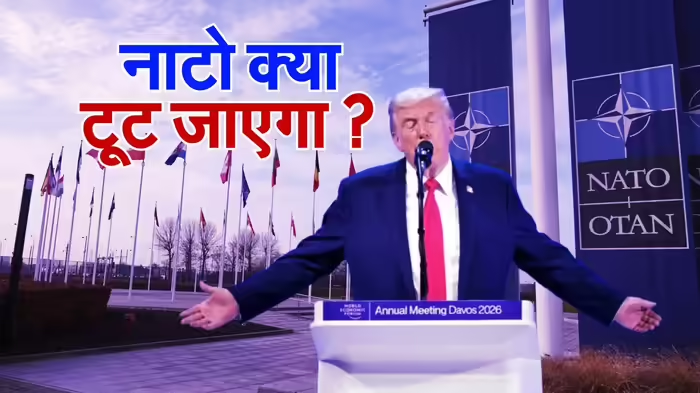
Paris/Washington: A serious geopolitical crisis is brewing between the United States and Europe over Greenland, as former US President Donald Trump signals a renewed push to bring the strategically vital Arctic island under American control—even if it means using military pressure. Trump’s aggressive stance has alarmed European allies and raised unprecedented questions about the future of NATO, the world’s most powerful military alliance comprising 32 nations.
European capitals are responding with rare unity. France has reportedly moved its aircraft carrier closer to Greenland, while countries such as Germany, Britain, Italy and France have issued sharp warnings to Washington. With Greenland administered by Denmark—a NATO member—any unilateral American military action could strike at the very foundation of the alliance.
Why Trump Wants Greenland
Donald Trump has repeatedly described Greenland as “vital to US national security.” Behind the rhetoric lies Washington’s ambition to deploy its ambitious Golden Dome missile defence system in the Arctic, aimed at countering potential missile threats from Russia and China.
Greenland’s location makes it a critical node in early-warning radar coverage, space surveillance, and missile detection. At the heart of this strategy is the Pituffik Space Base (formerly Thule Air Base), a Cold War–era installation that has become a cornerstone of the US Space Force’s global architecture.
Europe Pushes Back as NATO Unity Cracks
Trump’s confrontational tone—marked by mockery of leaders such as UK Prime Minister Keir Starmer, French President Emmanuel Macron, and Italian Prime Minister Giorgia Meloni—has only deepened European resentment. The timing is especially sensitive, with Europe already stretched thin by the ongoing Ukraine war and growing fears of Russian escalation.
Trump has gone a step further by threatening punitive tariffs against European nations opposing his Greenland ambitions. Such pressure tactics have revived fears that Washington is willing to weaponise its dominance within NATO for unilateral gains.
NATO’s Article 5 Under Strain
NATO’s core principle, Article 5, states that an attack on one member is considered an attack on all. If the United States were to use force against Greenland, it would place NATO in an unthinkable position—one member acting militarily against another.
NATO Secretary General Mark Rutte recently acknowledged a hard truth before European lawmakers: without American military support, Europe cannot fully defend itself. His statement underscores Europe’s strategic dilemma—caught between resisting US pressure and relying on American power for security.
Is the US Really Leaving NATO?
Foreign affairs expert Dr Rajkumar Sharma, speaking to Russian media outlet Sputnik, dismissed the likelihood of a US exit from NATO but warned of deep structural changes.
“Trump’s Greenland rhetoric and pressure on NATO are part of his negotiation strategy and a broader attempt to reassert American supremacy within the alliance,” Sharma said. “By targeting Denmark, Trump aims to prevent Europe from pursuing true strategic autonomy.”
According to Sharma, a US withdrawal would shatter Europe’s collective security framework, forcing nations to prioritise national defence over alliance commitments.
Nuclear Debate Looms in Europe
Experts warn that if American security guarantees weaken, countries like Germany and Poland could begin serious debates over acquiring nuclear weapons. Britain and France, despite being nuclear powers, would be unable to replace the US as Europe’s primary security guarantor.
“France and the UK simply do not possess the capacity to defend the entire European continent the way the US does,” Sharma noted.
Greenland: Symbol of a Failing Global Order
Trump’s position on Greenland has been notably inconsistent—oscillating between threats of force and reassurances of restraint. However, his core belief remains unchanged: the Arctic island is strategically indispensable to America.
Reports emerging after the Davos Summit suggested that Washington and Copenhagen may have quietly discussed granting the US additional remote areas in Greenland for new military bases—claims that remain unconfirmed but have added fuel to the controversy.
As global tensions rise, Greenland has become a litmus test for the weakening of the post-war, rules-based international order. The island’s strategic value, combined with great-power rivalry and alliance politics, is exposing fault lines that could redefine transatlantic relations for decades.
Conclusion
The Greenland standoff is no longer just about territory—it is about power, alliances, and the future of global security. Whether NATO adapts, fractures, or fundamentally transforms may depend on how far the United States—and Europe—are willing to go in this high-stakes geopolitical confrontation.
Discover more from SD NEWS agency
Subscribe to get the latest posts sent to your email.