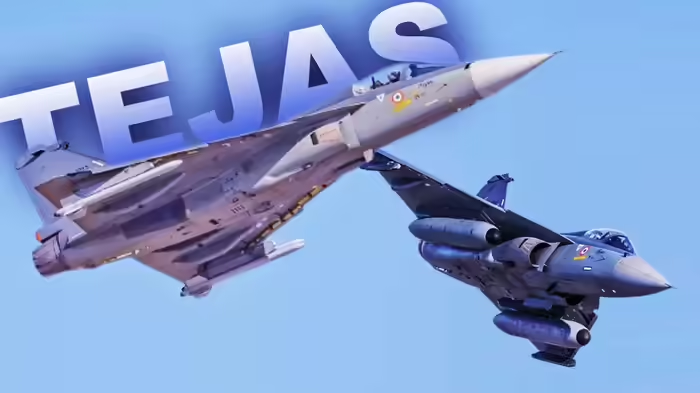
Brasília: The tragic crash of India’s Tejas fighter jet during the Dubai Airshow last month—an incident that claimed the life of pilot Namansh Syal—was viewed by many as a setback for India’s defence aviation ambitions. The Tejas Mk-1 aircraft plunged to the ground on 21 November during an aerobatic manoeuvre, erupting into flames and raising concerns about international perception.
However, contrary to initial apprehensions, global defence experts continue to express strong confidence in the Tejas programme. According to a report by IDRW, leading Brazilian analyst Patrícia Marins has advocated for sustained investment in Tejas despite the crash, emphasising that the aircraft holds significant promise for the future.
“Tejas Will Hold Its Own in Future Air Combat” — Expert
Patrícia Marins, an expert on Europe and Eurasia, stated that Tejas is difficult to detect on radar and works exceptionally well as a complementary aircraft to the Indian Air Force’s Su-30MKI fleet. She further added that Tejas will also be capable of coordinating operations with next-generation fighters such as Russia’s Su-57.
“In modern aerial combat, victory depends on missile range and accuracy, combined with radar power and scan speed,” she explained. “This is why even Russia is working on a smaller variant of the Su-57. The same trend is visible in Europe with aircraft like the Rafale and Saab Gripen.”
Why Tejas Stands Out
Marins highlighted several key strengths of the aircraft:
- Low Radar Visibility:
Tejas’ delta-wing design and composite materials make it less visible on enemy radar, enhancing survivability. - Advanced GaN-based Radar:
Tejas will be equipped with a cutting-edge Gallium Nitride (GaN) AESA radar, significantly boosting detection range, resistance to jamming, and overall performance. - Stronger Export Potential:
With advanced radar and avionics, Tejas will become more attractive to international buyers, Marins said.
India’s Indigenous Fighter Programme
The Tejas Mk-1 is India’s indigenous multirole fighter aircraft, developed by the Aeronautical Development Agency (ADA) and produced by Hindustan Aeronautics Limited (HAL). The Indian Air Force currently operates 40 Tejas Mk-1 aircraft across two squadrons.
The upcoming variants promise significant upgrades:
- Tejas Mk-1A:
Equipped with the indigenous Uttam AESA radar and upgraded digital fly-by-wire controls. Deliveries are expected to begin in 2027. - Tejas Mk-2:
Powered by GE’s F414 engine, with higher payload capacity and expanded mission capability. It is expected to enter service by 2030.
Setbacks But Strong Track Record
The Dubai crash marks the second major incident involving Tejas, following an engine seizure in Jaisalmer in 2024. Despite these cases, HAL Chairman D. K. Sunil has firmly defended the aircraft’s reputation.
“Tejas is among the safest fighter jets in the world,” Sunil said. “Its operational record is a testament to India’s technological strength and growing self-reliance in defence manufacturing.”
Global Trust Remains Intact
Though the Dubai Airshow tragedy was a heavy blow, international experts believe the long-term prospects of the Tejas programme remain strong. With continued upgrades, indigenous radar systems, and a clear development roadmap, Tejas is expected to secure a prominent place in the global light fighter market.
Discover more from SD NEWS agency
Subscribe to get the latest posts sent to your email.