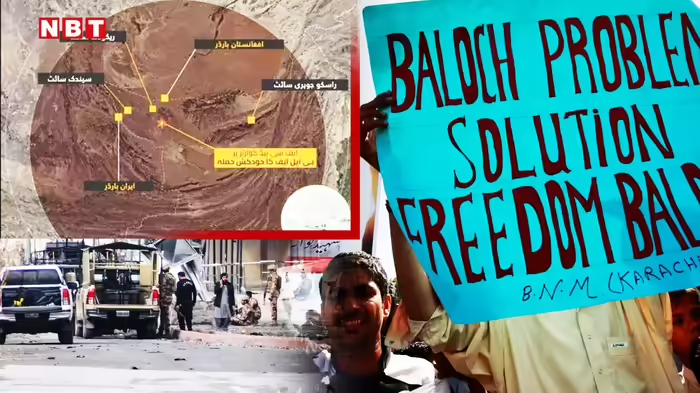
Islamabad: In a coordinated assault across 12 cities in Balochistan, Pakistan witnessed the most significant insurgent attack in decades on Saturday. The Balochistan Liberation Army (BLA) claimed responsibility, emphasizing that their objective is the province’s independence from Pakistan.
The attacks targeted major military installations, police stations, paramilitary posts, and civilian areas, and included both suicide bombers and female combatants. The scale of the operation has sent alarm signals to China and the United States, which have heavily invested in the underdeveloped region. Balochistan is rich in natural gas and rare minerals, and hosts China’s multi-billion-dollar China-Pakistan Economic Corridor (CPEC) projects, while the U.S. also maintains strategic interest in the area.
“HeroF 2”: The Operation That Shook Pakistan
The BLA dubbed the attack “HeroF 2”, drawing on a Balochi literary term meaning “Black Storm”, often referenced in Balochi poetry. Earlier, in HeroF 1 (2024), the insurgents had targeted only police personnel.
According to reports from The Express Tribune, simultaneous gun and bomb attacks occurred in Quetta, Noshki, Mastung, Dalbandin, Kalat, Kharan, Panjgur, Gwadar, Pasni, Turbat, Tamp, Buleda, Mangochar, Lasbela, Kech, and Awaran. The Pakistan Intelligence Bureau estimated 800–1,000 BLA fighters were involved.
Key incidents included:
- Quetta: Insurgents heavily armed, attacked police stations and mobile units, detonating bombs in central areas.
- Mastung: Attack on central jail freed at least 30 prisoners.
- Gwadar: Assault on migrant worker camps killed 11.
- Kalat: Deputy Police Commissioner’s headquarters and police lines blown up.
- Nushki: Deputy Commissioner Hussein Hazara kidnapped with family.
- Pasni: Coastal Guard post destroyed, multiple casualties.
- Bolan, Lak Pass, Kila Saifullah-Rakhni: Highways blocked.
- Nasirabad: Railway lines rigged with explosives, later defused.
Media reports estimate over 200 deaths, with Balochistan Chief Minister Sarfaraz Bugti confirming 31 civilians and 17 security personnel killed. The Pakistani army claims 145 BLA insurgents were killed, although the BLA disputes these figures, claiming 84 security personnel killed, 18 officers captured, and 7 BLA fighters dead, including four suicide attackers.
Why Balochistan Matters
As Pakistan’s largest province, Balochistan shares borders with Iran and Afghanistan, and its coastline gives it strategic importance. Gwadar port, developed under CPEC, links China with the Middle East and Central Asia. The province is rich in natural gas, coal, copper, gold, and rare-earth minerals, including the Sui gas fields, which significantly contribute to Pakistan’s energy supply.
A Region of Strategic Concerns for China and the U.S.
Balochistan’s geography makes it extremely difficult for any army to maintain full control. While insurgents can launch attacks with relative ease, the cost of security for the state is high. Widespread resentment against the Pakistani military and government, due to decades of oppression, ensures local support for the insurgents.
According to a Georgetown Journal of International Affairs study, Balochistan is Pakistan’s poorest province, and locals receive a disproportionately small share of resource revenues—12.5% for gas royalties, with the majority going to Punjab—fuelling grievances. Without meaningful reforms and negotiations with the Baloch, the province’s instability is likely to persist, posing a serious challenge to Pakistan and foreign investors alike.
Discover more from SD NEWS agency
Subscribe to get the latest posts sent to your email.