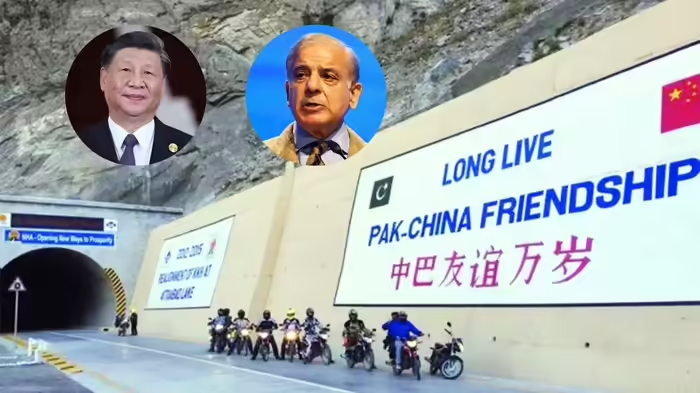
Rome/New Delhi: Growing political and security instability in Pakistan is raising serious concerns over the future of the China-Pakistan Economic Corridor (CPEC). According to a report by Italy’s Institute for International Political Studies (ISPI), the recent unrest in Pakistan threatens the progress of CPEC and has heightened Beijing’s anxiety over its multi-billion-dollar investments.
Report Highlights Rising Risks
The ISPI report warns that if Chinese officials cannot travel safely within Pakistan, Beijing may be forced to reconsider its engagement in the region. The report notes that every new challenge faced by Islamabad now poses a potential risk to CPEC’s development and the billions of dollars China has invested in Pakistan.
The report highlights that China’s ambitions to strengthen its influence over Afghanistan and Pakistan, and to establish economically prosperous and stable zones along Pakistan’s western and southwestern borders, are increasingly challenged by recent events.
Pakistan-Taliban Tensions and Security Threats
The ISPI report also references heightened tensions in October 2025 between Pakistan and the Afghan Taliban, including deadly missile strikes along their shared border. Relations between Pakistan and the Taliban have been deteriorating since the Taliban’s return to power in Kabul in September 2021.
$62 Billion at Stake
China’s investment in Pakistan, totaling around $62 billion, was made nearly a decade ago with the aim of creating a direct infrastructure link to the Arabian Sea, centered around Gwadar Port in Balochistan. The report warns that domestic insurgency, combined with regional instability, threatens Beijing’s ability to achieve expected returns from CPEC.
Baloch insurgency has particularly disrupted CPEC projects. Continuous attacks by the Balochistan Liberation Army (BLA) have impeded major initiatives, including Gwadar Port development. Security conditions were so severe that the inauguration of the CPEC-funded Gwadar airport in late 2024 had to be conducted virtually due to safety concerns for senior officials.
In addition, Pakistan faces threats from Tehrik-i-Taliban Pakistan (TTP), which has repeatedly targeted both security forces and Chinese infrastructure projects in Khyber Pakhtunkhwa. These attacks have further hindered progress and heightened concerns for the security of Chinese personnel and investments.
Conclusion
The ISPI report underscores that Pakistan’s internal unrest and regional security challenges have put China’s strategic and economic stakes at risk, casting doubt on the timely and secure completion of several critical CPEC projects.
Discover more from SD NEWS agency
Subscribe to get the latest posts sent to your email.