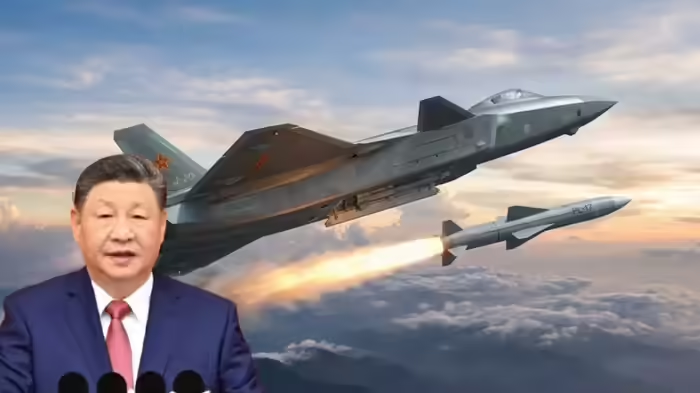
Beijing: China’s PL‑17 air‑to‑air missile, considered one of the most secretive weapons of the People’s Liberation Army Air Force (PLAAF), has reportedly been seen up close for the first time. The missile, believed to be significantly more capable than the widely discussed PL‑15, has drawn global attention due to its exceptional range, size, and speed.
The PL‑17 is a long‑range air‑to‑air missile designed primarily to target high‑value aerial assets such as airborne early warning aircraft, surveillance platforms, and aerial refuelling tankers. Although the missile has existed for years, China has never officially released its specifications, making this recent visual sighting particularly noteworthy.
According to defence analysts and reports cited by The War Zone, the missile seen appears to be a full‑scale model, possibly displayed at a Chinese defence exhibition. A blurred individual was photographed posing next to the missile, with promotional material for China’s J‑20 stealth fighter visible in the background. Earlier images of the PL‑17 surfaced nearly a decade ago but were unclear and lacked detail.
Range, Speed, and Design
Initial assessments suggest the PL‑17 is nearly 20 feet long, indicating a very‑long‑range engagement role. Reports estimate its range to be around 250 miles (approximately 400 km), far exceeding the PL‑15’s 200 km range. The missile is believed to reach speeds of Mach 4, though actual performance may vary based on combat conditions.
The PL‑17 is thought to be powered by a dual‑pulse rocket motor, enhancing its end‑game performance. Control is reportedly achieved through four small tail fins and thrust‑vectoring, providing high manoeuvrability at extreme ranges.
Advanced Guidance System
Experts believe the missile uses a two‑way data link combined with an AESA (Active Electronically Scanned Array) radar seeker, making it highly resistant to electronic countermeasures. Some reports also suggest the presence of a passive anti‑radiation seeker, enabling it to home in on radar‑emitting targets.
While the missile may not be optimised for dogfighting against agile fighter jets, it is considered especially effective against AEW&C and GMTI aircraft, which are critical force multipliers in modern warfare.
Integration with Chinese Fighter Jets
The PL‑17 has previously been observed mounted on the J‑16 fighter, and there is growing speculation that it has now been integrated with the J‑20 stealth fighter. However, since the missile appears to be carried externally, it could compromise the J‑20’s stealth characteristics.
Due to its large size, analysts believe it is unlikely to be integrated with J‑10C or J‑35 fighters. There is speculation that China may eventually deploy the PL‑17 on its future sixth‑generation J‑36 fighter, allowing the missile to exploit its full operational potential.
Export Unlikely, Pakistan Threat Minimal
Given its size, strategic value, and sensitivity, experts believe the PL‑17 is highly unlikely to be exported, including to Pakistan. As a result, the immediate threat of its deployment on the India‑Pakistan front is considered minimal. However, defence experts caution that India must remain vigilant and prepared for evolving aerial threats in the region.
Discover more from SD NEWS agency
Subscribe to get the latest posts sent to your email.