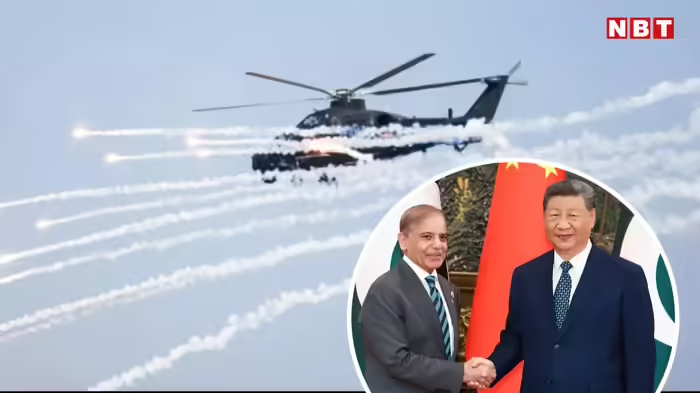
In the aftermath of India’s Operation Sindoor, which exposed serious vulnerabilities in Pakistan’s military defenses, China has begun training Pakistan in advanced drone swarm warfare, signaling a new phase of military preparedness aimed at countering India’s superior missile and air power.
During Operation Sindoor, Pakistan’s conventional weapons systems failed to inflict any significant damage on India, while Indian missiles destroyed 11 Pakistani airbases and completely wiped out nine terror camps in Pakistan and Pakistan-occupied Kashmir (PoK). Following the operation, Pakistani military experts openly admitted that Islamabad lacks effective countermeasures against India’s precision missile strikes.
Shift to Drone Swarm Strategy
In response, Pakistan has been advised by its military strategists to adopt asymmetric warfare tactics, particularly drone swarm attacks, to offset India’s technological edge. Acting on this strategy, China has conducted a joint military exercise with Pakistan, placing special emphasis on drone swarm operations and integrated air‑ground combat.
According to a report by the Chinese Communist Party’s mouthpiece Global Times, the latest China‑Pakistan Warrior‑IX joint counter‑terrorism exercise, concluded last week in Pakistan, featured advanced unmanned systems and the Z‑10 attack helicopter, which is widely viewed as China’s response to the U.S.-made Apache helicopter used by India.
Drone swarm warfare involves launching dozens to hundreds of drones simultaneously, overwhelming even advanced air defense systems by sheer volume and coordination. Defense analysts warn that such tactics significantly increase the risk of damage, as interception systems struggle to track and neutralize multiple targets at once. The effectiveness of this strategy was recently demonstrated in the Ukraine conflict, where drone swarms reportedly destroyed multiple Russian fighter aircraft in a single operation.
Live‑Fire Drills and Integrated Combat Training
Global Times reported that the December exercises focused on integrated joint training, combining ground forces, air assets, and unmanned platforms. In the final phase, Chinese and Pakistani troops conducted full‑process, full‑element live‑fire drills, including joint air‑ground operations using a wide array of unmanned equipment.
China’s official military social media handle, China Military Bugle, stated that the exercises included training in mountain warfare, hostage rescue operations, coordinated fire strikes, and deep‑penetration missions. The drills featured medium‑ and high‑altitude long‑endurance drones, drone swarms, loitering munitions, and explosive‑disposal robots.
These systems were used for surveillance, reconnaissance, area domination, target neutralization, and simulated destruction of terrorist hideouts deep inside enemy territory.
Fear of India’s Next Strike
Defense experts believe that China’s intensified military training support to Pakistan stems from a shared concern in Beijing and Islamabad that India may launch a future “Operation 2.0”. The joint drills underline China’s role in reshaping Pakistan’s military doctrine, shifting focus from conventional warfare to high‑tech, unmanned, and hybrid combat strategies.
The evolving China‑Pakistan military cooperation is being closely monitored by regional security analysts, as it has significant implications for South Asia’s strategic balance and future conflict dynamics.
Discover more from SD NEWS agency
Subscribe to get the latest posts sent to your email.