Tokyo/Beijing.
A fresh wave of tension has erupted in East Asia after Chinese and Russian fighter jets forced Japanese and South Korean aircraft to scramble during a high-intensity joint patrol over the Japan Sea. The encounter comes at a time when relations between Japan and China are already strained due to Tokyo’s mounting support for Taiwan in the event of a regional conflict.
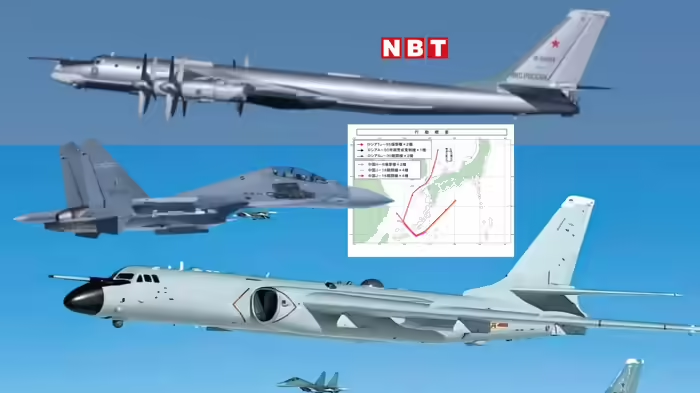
According to Japan’s Ministry of Defence, two Russian Tu-95 “Bear” strategic bombers flew southward from the Sea of Japan into the East China Sea. After passing between western Japan and southeastern South Korea, the Russian aircraft joined two Chinese H-6 series bombers near Okinawa. The combined formation then undertook a long-range joint flight from the East China Sea to the Pacific Ocean, flying past the coast of Shikoku.
The ministry further reported that four Chinese J-16 multirole fighters later joined the bomber formation, making multiple passes between Okinawa Island and Miyako Island. Eventually, the Russian bombers returned north to the Sea of Japan, while the Chinese aircraft headed back toward the mainland.
South Korea Scrambles Jets After Airspace Breach
South Korea’s Joint Chiefs of Staff confirmed that two Chinese and seven Russian military aircraft entered the Korea Air Defense Identification Zone (KADIZ) without prior notification. In response, South Korea deployed its fighter jets to monitor the intrusions. The foreign aircraft remained in the zone for nearly an hour before leaving.
Since 2019, China and Russia have routinely conducted such exercises—often once or twice a year—without prior warning, raising the risk of aerial confrontation. A similar incident occurred in November 2024 when 11 military aircraft from both nations ventured into the KADIZ.
Flashpoint Near Okinawa: Chinese J-15 Locks on to Japanese F-15
Tensions escalated dangerously when Chinese J-15 fighter jets, launched from an aircraft carrier, reportedly locked their targeting radar onto a Japanese F-15 near Okinawa. Tokyo insists its aircraft were maintaining a safe distance, whereas Beijing accuses Japan of interfering in its training mission.
China later released audio of what it claimed was a warning issued to Japanese pilots, while Japan stated that Chinese officials failed to respond on the bilateral military hotline.
Japan Strengthens Its Defences Near Taiwan
Amid the rising uncertainty, Japan has rapidly intensified its military preparedness across the region. Last week, Tokyo announced the deployment of a new electronic warfare air-defence unit on Yonaguni Island, located merely 70 miles from Taiwan. Japan had earlier revealed plans to station an air-defence missile system on the same island.
This growing militarisation underscores Japan’s strategic signalling: Tokyo has openly stated that it would support Taiwan in case of an attack, a stance that has sharply worsened its relations with Beijing.
China–Russia Partnership Expands Beyond East Asia
Military analysts note that the China–Russia defence partnership is no longer confined to the East China Sea. Last year, bombers from both countries jointly flew as far as Alaska’s Air Defense Identification Zone (ADIZ), indicating a broader push to challenge U.S. and allied influence across the Indo-Pacific.
A New Power Struggle in the Indo-Pacific
The latest aerial stand-off demonstrates how quickly the security environment is deteriorating across the region. With Japan stepping up its defence posture near Taiwan and China deepening military coordination with Russia, experts warn that the contest for strategic dominance in the Indo-Pacific is intensifying—and may soon reach a critical tipping point.
Discover more from SD NEWS agency
Subscribe to get the latest posts sent to your email.