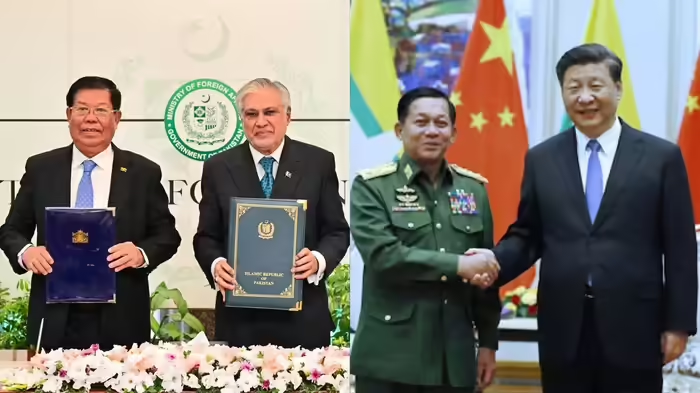
Experts have warned that China and Pakistan are actively working to reduce India’s influence in its neighboring countries, including Bangladesh and Myanmar, creating new geopolitical challenges for Delhi.
Myanmar shares borders with several Indian states, making developments there critical to India’s regional security. On January 24, Myanmar’s Foreign Minister Than Swe arrived in Pakistan for a four-day visit aimed at improving bilateral ties. Analysts suggest that this move reflects Pakistan’s increasing influence in Myanmar, complementing China’s already strong presence in the country. Both Pakistan and China have historically strained relations with India, heightening concerns over India’s diminishing leverage in the region.
China’s Growing Influence
Since the 2021 military coup in Myanmar, China has steadily expanded its influence, maintaining contact with all key actors, including the junta and powerful ethnic armed groups. China has long provided weapons and training to Myanmar’s military. Last year, Myanmar’s junta leader Min Aung Hlaing visited Tianjin, China, at the invitation of President Xi Jinping to attend the Shanghai Cooperation Organization summit, reinforcing Beijing’s strategic foothold.
Challenges for India
Dr. Sriradha Datta of O.P. Jindal Global University said, “India faces more complexities in Myanmar compared to Bangladesh. While India has historically worked with the military and power structures, civil society expects India to deepen its engagement to counter China’s influence, which is not easy. Pakistan’s entry into Myanmar complicates the situation further.”
Dr. Angshuman Chaudhary of the National University of Singapore added, “India had hoped that its longstanding relations with the junta would counter China’s influence. However, Beijing has maintained strong ties with both the junta and Myanmar’s ethnic armed groups, limiting India’s effectiveness.”
Strategic Projects and Competing Interests
India is involved in major infrastructure projects in Myanmar, including a $484 million corridor connecting the Sittwe port in Rakhine to Kolkata via river, sea, and road routes. Meanwhile, China is developing multi-billion-dollar rail and road projects linking Kyaukpyu in Rakhine to Yunnan Province, cementing its long-term strategic presence.
Regional Influence and Indian Policy
Former Indian diplomat K.P. Fabian notes that India’s policy of deepening ties with neighboring countries has weakened in recent years. While India relied heavily on Sheikh Hasina’s government in Bangladesh, its influence over Myanmar’s military has been limited. Fabian warns that China and Pakistan are coordinating to curb India’s emergence as a regional leader by increasing their influence in Bangladesh and Myanmar.
Maintaining Indian Influence
Nilanthi Samaranayake, an adjunct fellow at the East-West Center in Washington, observes that India still retains regional influence. “Despite challenges, India has strengthened ties with the Maldives and Sri Lanka. However, it cannot ignore the growing strategic competition in Myanmar and Bangladesh,” she said.
The unfolding situation underscores the urgent need for India to maintain and expand its influence in Myanmar and other neighboring countries, balancing China and Pakistan’s growing presence to safeguard its geopolitical interests in the region.
Discover more from SD NEWS agency
Subscribe to get the latest posts sent to your email.