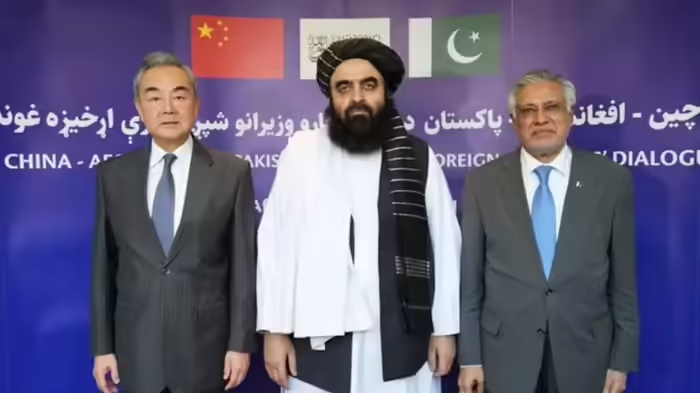
Islamabad/New Delhi: China and Pakistan are moving closer to extending the China-Pakistan Economic Corridor (CPEC) into Afghanistan, a strategic development that could significantly alter regional dynamics while sidelining India’s long-standing objections to the project. The proposal was discussed in detail during a recent meeting of the Pakistan Senate’s Standing Committee on Foreign Affairs, where officials reportedly indicated that key decisions regarding the corridor’s expansion have nearly been finalised.
If implemented, the extension of CPEC into Afghanistan would mark a major geopolitical win for Beijing and Islamabad, while raising concerns in New Delhi, which has steadily expanded its diplomatic and developmental footprint in Afghanistan in recent years.
According to Pakistani media reports citing officials from the Foreign Office, preparatory steps have already been taken to establish a trilateral framework involving China, Pakistan and Afghanistan. The initiative is being projected as a mechanism to boost regional connectivity, economic integration and trade cooperation across South and Central Asia.
Pakistani Experts Raise Red Flags
However, the plan has drawn criticism from within Pakistan itself. Prominent Pakistani journalist and security analyst Imtiaz Gul has questioned the government’s priorities, warning that ambitious infrastructure plans cannot succeed without addressing pressing ground realities.
Writing in The Express Tribune, Gul urged the Shehbaz Sharif-led government to first reopen the Pakistan–Afghanistan border, which has remained closed since October 11, 2025. The prolonged closure has disrupted cross-border trade, triggering economic distress, particularly in Khyber Pakhtunkhwa, where millions depend on border commerce for their livelihoods.
“Before talking about extending CPEC into Afghanistan, Pakistan must restore normal trade relations at the border,” Gul argued, cautioning that unresolved tensions undermine Islamabad’s credibility as a reliable transit and trade partner.
Ground Realities Challenge CPEC Expansion
Experts note that despite multiple trade and transit agreements between Pakistan and Afghanistan, ongoing tensions over the past four months have rendered many of these arrangements ineffective. The breakdown in cross-border trade has raised doubts about Pakistan’s ability to deliver on large-scale regional connectivity projects such as CPEC.
While extending the corridor into Afghanistan could offer long-term economic benefits, analysts stress that security concerns, political instability and strained bilateral relations pose serious challenges to its feasibility.
The Taliban-led government in Kabul has yet to formally clarify its position on the proposed expansion, adding another layer of uncertainty to the initiative.
India’s Opposition Remains Firm
India has consistently opposed CPEC, primarily because parts of the corridor pass through Pakistan-occupied Kashmir (PoK), which New Delhi considers illegally occupied territory. India also views the project as a strategic tool for expanding China’s influence in the region, particularly along its western and northern borders.
The potential inclusion of Afghanistan into the CPEC framework is therefore seen in New Delhi as a further strategic setback, reinforcing concerns about growing China-Pakistan coordination in India’s immediate neighbourhood.
As Beijing and Islamabad push forward with their plans, regional observers believe the success of the CPEC expansion will ultimately depend not on diplomatic announcements, but on resolving deep-rooted political, security and economic challenges on the ground.
Discover more from SD NEWS agency
Subscribe to get the latest posts sent to your email.