Washington: The Pentagon has submitted a detailed report to the U.S. Congress highlighting the evolving dynamics of India-China relations, with a special focus on Arunachal Pradesh. The report emphasizes China’s rise and the significant geopolitical shifts underway in Asia.
According to the report, China’s long-term strategy aims for the “great rejuvenation of the Chinese nation” by 2049. Under this vision, Beijing is not only striving to expand its global influence but is also building a world-class military capable of fighting and winning wars.
The Pentagon underscores that China prioritizes the protection of its sovereignty, security, and developmental interests. To achieve these goals, it continues to strengthen both its internal and external security frameworks.
China’s Core Interests and Arunachal Pradesh
The report outlines three “core interests” central to China’s national strategy:
- Absolute control of the Chinese Communist Party (CCP)
- Economic development of the nation
- Protection and expansion of China’s sovereignty and territorial claims
As part of these core interests, Beijing includes Taiwan, the South China Sea, the Senkaku Islands, and Arunachal Pradesh—considering Arunachal as a national priority. This designation indicates that disputes over Arunachal Pradesh may intensify in the coming years.
The Pentagon also highlights that the CCP is extremely sensitive to any perceived threats to its rule or domestic criticism. It does not want any signal suggesting that the CCP is failing to protect Chinese interests. To reinforce its authority, the CCP labels dissenting political voices in Hong Kong, Xinjiang, Tibet, and Taiwan as separatist forces with external backing, viewing them as unacceptable threats to its legitimacy and power.
LAC Developments and India-China Engagement
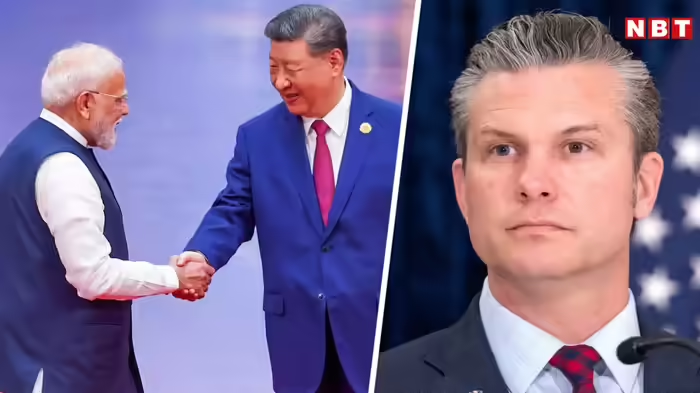
The report notes that in October 2024, ahead of the BRICS Summit, Indian leadership announced a deal with China to de-escalate remaining friction points along the Line of Actual Control (LAC). The summit meeting between President Xi Jinping and Prime Minister Narendra Modi marked the start of high-level engagements aimed at managing borders and advancing bilateral cooperation, including direct flights, visa facilitation, and exchanges for scholars and journalists.
Pentagon analysts believe China may be seeking to stabilize bilateral ties by reducing tension along the LAC, potentially to limit deepening India-U.S. relations. However, India remains cautious of China’s actions and intentions. Persistent mistrust and unresolved issues are likely to restrict the scope of normalized relations.
In conclusion, the report suggests that while China appears eager to normalize ties with India, deep-rooted skepticism in New Delhi and ongoing disputes may continue to constrain bilateral engagement.
Discover more from SD NEWS agency
Subscribe to get the latest posts sent to your email.