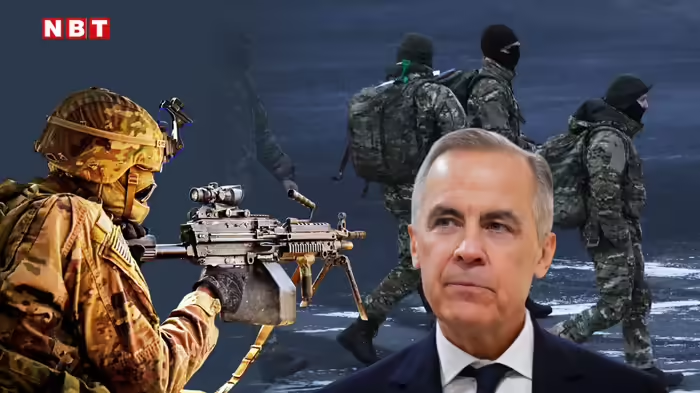
Washington/Ottawa: Tensions between Canada and the United States have escalated as President Donald Trump continues to issue threats, accuse Canada of sending drugs into the U.S., and suggest that Canada could become the 51st state. Recently, Trump even posted a map depicting Canada as part of the United States, raising alarm in Ottawa.
Canadian military officials have reportedly developed a model to respond to a potential U.S. military attack—the first such plan in 100 years. The Globe and Mail reported that the Canadian Armed Forces are preparing scenarios to defend against a possible strike from the south, though the identities of the sources were not disclosed.
NATO and the Threat Perception
The plan emerges at a time when Trump’s aggressive rhetoric has challenged NATO allies and raised questions about the stability of the international order. From threats over Greenland to Venezuela, Trump’s statements have unsettled not only adversaries but also longtime U.S. partners. Canada, a founding NATO member and partner in North American air defense, is particularly concerned about the implications.
Canada’s Response and Strategic Planning
Senior Canadian military officials told The Globe and Mail that conventional forces alone would be insufficient to resist a U.S. attack. According to the plan, American forces could potentially seize strategic Canadian positions within days to a week. As a result, the Canadian Armed Forces are considering unconventional defense strategies, including irregular militias, armed civilian groups, drone warfare, and hit-and-run operations to inflict maximum damage on invading forces.
The model draws inspiration from strategies used by Afghan mujahideen against the Soviet Union (1979–1989) and later by the Taliban during 20 years of conflict against U.S. and allied forces. The aim is to impose significant costs on any occupying military power.
A Clear Signal to Washington
Canada’s military planning underscores the growing mistrust toward the Trump administration. Prime Minister Mark Carney, speaking at the World Economic Forum in Davos, stated that the old global order dominated by U.S. hegemony is ending. He warned that the previous world system was unjust, favoring the powerful while disadvantaging the vulnerable—a statement widely interpreted as a direct caution to the United States.
The combination of Canada’s new military strategy and Carney’s diplomatic signals illustrates a significant shift in North American geopolitics, as Ottawa prepares to defend its sovereignty in the face of an increasingly unpredictable U.S. administration.
Discover more from SD NEWS agency
Subscribe to get the latest posts sent to your email.