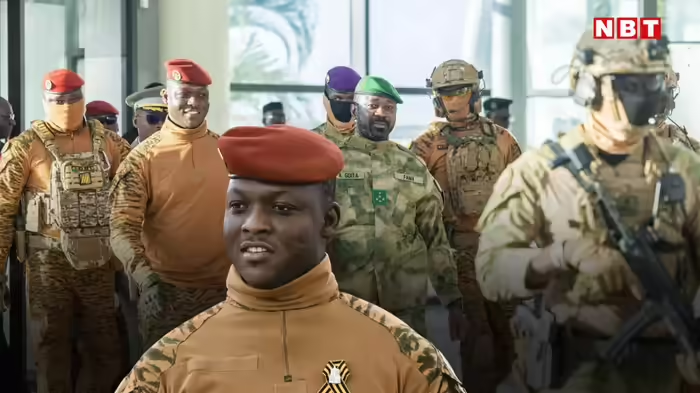
The government of Burkina Faso, a key nation in Africa’s Sahel region, has officially dissolved all political parties in the country. The order also transfers the assets of these parties to the state, marking a historic consolidation of power under the military leadership of Captain Ibrahim Traoré.
“Political Parties Divide Society”
Since taking power following a coup in September 2022, Captain Traoré has enacted a series of sweeping measures, consolidating control over the West African nation. In its latest decree, the government justified the dissolution of political parties by arguing that they foster social division and weaken the national fabric.
Minister of Interior Emile Jerbo stated that the decision is part of a broader national reconstruction plan. “Our review found that political parties often amplify divisions and compromise social cohesion,” Jerbo said. Burkina Faso’s government faces ongoing security challenges, including threats from ISIS and Al-Qaeda affiliated groups, and Traoré’s administration has been actively conducting counter-terrorism operations.
Historical Context
Before military rule, Burkina Faso had a multi-party political system, with over 100 registered parties. In the 2020 general elections, 15 parties were represented in the national assembly. Since the 2022 coup, the country has been under the direct control of Captain Traoré. Prior coups include the removal of President Roch Marc Kaboré, highlighting a pattern of political instability in the country.
Foreign Relations and Regional Alliances
Under Traoré, Burkina Faso has shifted its foreign policy, severing ties with its former colonial ruler France and seeking security cooperation with Russia. In 2024, the government ordered internet service providers to block Western news websites, including BBC and Voice of America. Traoré also visited Russian President Vladimir Putin to strengthen bilateral ties.
Regionally, Burkina Faso has partnered with neighboring Mali and Niger, both under military governments, to form a Sahel-wide alliance focused on military and economic cooperation. These measures underscore Traoré’s vision of a unified, militarily secured Sahel region, though they have drawn international attention and concern over democratic governance and human rights.
With the formal dissolution of political parties, Burkina Faso enters a new era under Captain Ibrahim Traoré, emphasizing centralized authority and a military-led approach to governance in a region historically fraught with instability.
Discover more from SD NEWS agency
Subscribe to get the latest posts sent to your email.