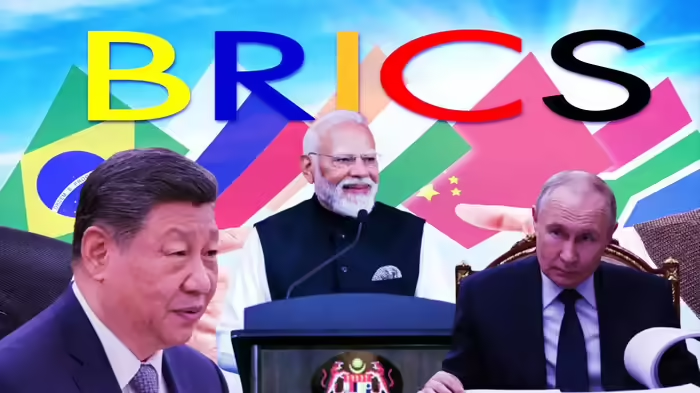
New Delhi: The expansion of BRICS into the BRICS+ framework, intended to increase the bloc’s global influence, is now revealing significant internal fissures among its member nations. Differences in strategic priorities and alliances are causing friction, raising questions about the bloc’s cohesion and effectiveness.
Diverging Interests and Alliances
Some BRICS+ members align closely with the United States, others with China, and yet others follow India’s multi-alignment strategy. This divergence is leading to conflicting interests. Countries like Saudi Arabia and the United Arab Emirates, heavily tied to the U.S. dollar, are opposed to the idea of a BRICS currency. Meanwhile, India is advocating a framework for new payment systems rather than directly challenging the dollar, in contrast to China and Russia’s push for de-dollarization.
Davos 2026: Public Strains Come to Light
The 2026 World Economic Forum in Davos highlighted these tensions. Two major developments stood out: first, Donald Trump announced a ‘Board of Peace’ to aid Gaza’s reconstruction; second, BRICS+ nations publicly displayed differences for the first time, exposing structural vulnerabilities. Experts argue that these conflicts reflect the bloc’s inherent nature—while BRICS+ was envisioned as a UN-centered reformist group, its members have vastly different agendas, slowing decision-making and testing unity.
Structural Weaknesses of BRICS+
BRICS+ is heavily influenced by three pillars: China, Russia, and India, each with distinct priorities:
- China aims to use the bloc as an economic engine to challenge the U.S. dollar but finds many members unwilling to follow this approach.
- Russia focuses on maintaining and expanding its military capabilities while relying on China for economic and diplomatic support, creating dependency that destabilizes bloc cohesion.
- India exerts influence through its multi-alignment policy, having previously faced unilateral tariff actions by Trump in 2025, which weakened its U.S.-India relations and reaffirmed India’s independent approach within BRICS+.
Expansion Challenges
The 2024 BRICS+ expansion, including countries like Iran, Egypt, Ethiopia, the UAE, and Indonesia, was meant to strengthen the bloc. However, the result has been the opposite: adding diverse members with conflicting economic ties has diluted internal unity, creating a “hollow geopolitical footprint.” Consensus-based decision-making is increasingly difficult, particularly with countries tied to Western economies or opposed to de-dollarization.
U.S. Advantages
The structural slowdowns in BRICS+ contrast sharply with Trump’s Board of Peace (BoP), a private-equity-style initiative where decisions can be taken swiftly under a single leadership. By comparison, BRICS+ operates on multilateral consensus, making it slow to respond and vulnerable to internal disagreements. The U.S. benefits from these divisions, as BRICS+ struggles to present a united front on strategic economic and geopolitical initiatives.
Conclusion
While BRICS+ was intended as a force multiplier to challenge the existing dollar-dominated financial system, its expansion has instead exposed internal rifts and competing agendas. Divergent priorities among members, combined with varying alliances with the U.S., China, and regional powers, suggest that building a cohesive bloc may remain an increasingly uphill task.
Discover more from SD NEWS agency
Subscribe to get the latest posts sent to your email.