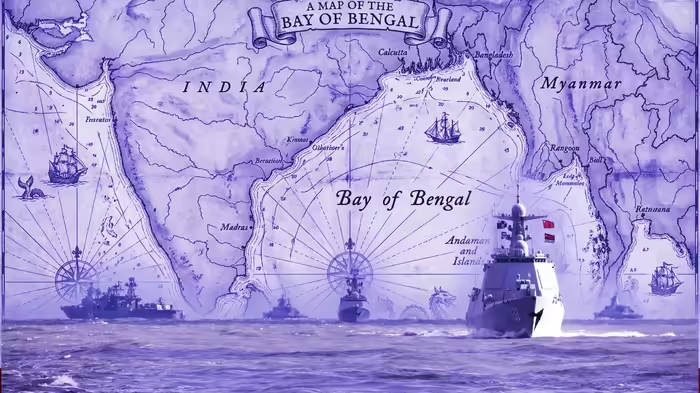
Beijing/New Delhi: The Bay of Bengal, once a vital trade corridor, is rapidly transforming into a theater of military competition, with China, Pakistan, and now Bangladesh challenging India’s traditional naval dominance. Recent developments indicate that the region is becoming a strategic flashpoint in South Asia.
A flotilla of Chinese People’s Liberation Army Navy (PLAN) vessels, including destroyers, frigates, and support ships, was recently spotted passing through the Andaman Sea and approaching the Bay of Bengal. This deployment follows a series of naval exercises under banners like “Peace and Friendship 2025”, signaling Beijing’s increasing footprint in the region.
Pakistan is also strengthening its presence, with its China-built guided-missile frigate PNS Saif visiting Bangladesh in November 2025. High-level meetings between Pakistani and Bangladeshi military officials indicate evolving strategic cooperation. Bangladesh itself has joined the Chinese camp, having received two submarines from Beijing, enhancing its underwater warfare capability. China has also established a submarine base near Chattogram, previously known as BNS Sheikh Hasina, and is upgrading infrastructure in Myanmar’s Coco Islands, while energy pipelines connecting to China further solidify its influence.
India Responds Strategically
India, however, is not sitting idle. On December 23, 2025, the Indian Navy successfully tested the K-4 intermediate-range ballistic missile from the nuclear-powered submarine INS Arighat, marking a key milestone in integrating its missile, submarine, and command-control capabilities.
In addition, India has started developing a new naval base near Haldia, close to Bangladesh, for Fast Interceptor Crafts (FICs) and New Water Jet Fast Attack Crafts (NWJFACs). Strategically located about 100 km from Kolkata along the Bay of Bengal, this base will enhance India’s monitoring and response capabilities in the region. The base complements existing naval infrastructure, including the Eastern Naval Command in Visakhapatnam and facilities in the Andaman and Nicobar Islands.
FICs are small, fast vessels weighing around 100 tons, capable of speeds up to 45 knots, armed with machine guns, and carrying 10–12 personnel for a variety of missions. The Haldia facility is expected to significantly boost India’s ability to monitor and counter adversarial activities in the Bay of Bengal.
Strategic Implications
Analysts suggest that the Bay of Bengal is now rapidly turning into a “chessboard” of strategic competition. While external powers are attempting to turn the region into a contested zone, India continues to assert its dominance, leveraging advanced naval capabilities and strategic infrastructure to maintain its edge.
The unfolding developments underline that the Bay of Bengal is no longer just a maritime trade route—it is the frontline of a high-stakes strategic contest that could shape South Asia’s security landscape for decades to come.
Discover more from SD NEWS agency
Subscribe to get the latest posts sent to your email.