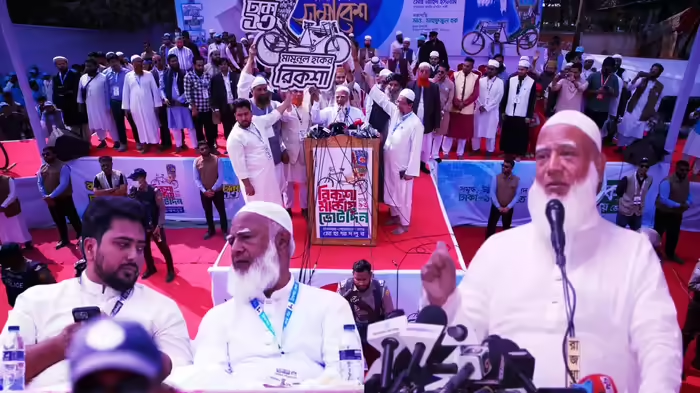
Dhaka: Voting is underway today for 299 of Bangladesh’s 300 parliamentary seats, marking a critical juncture in the country’s political landscape. Of the total 350 seats, 50 are reserved for women and not contested. One seat is pending due to the death of a candidate. Today’s election could determine whether Bangladesh continues on a path of religious extremism or moves toward a more liberal, inclusive society—making it a do-or-die moment for Jamaat-e-Islami.
With the Awami League barred from contesting, Jamaat’s main competition comes from the Bangladesh Nationalist Party (BNP). Intelligence reports suggest that Jamaat’s influence on the ground has grown in recent months, particularly among Hindu voters, with the party reportedly promising protection to minority communities and even deploying activists outside Durga Puja pandals.
Key Appointments and Influence
Under interim leader Mohammad Yunus, Jamaat supporters hold several key administrative positions, including:
- Home Secretary: Nasimul Ghani, former head of Hizb-ut-Tahrir
- Chief Election Commissioner: AMM Nasir Uddin
- Anti-Corruption Commissioner: Mohammad Abdul Momen
These officials, closely aligned with Jamaat, have reportedly worked under Yunus’ direction to promote Islamic ideology in governance. Analysts, however, remain uncertain whether Jamaat will rely on conventional electoral methods or other strategies to maximize its seat count.
Jamaat’s Electoral Promises
Jamaat’s student wing, Islami Chhatra Shibir, has pledged that if the party comes to power:
- All government offices and courts will operate without bribery
- Monopoly and bureaucratic-criminal nexus in business will end
- Essential goods’ prices will be controlled
- Women and girls can move freely without fear
- Forced extortion, terror-related activities, and rape will be curtailed
However, the party has also warned that if any other party wins, including BNP, law and order could deteriorate, suggesting a dual narrative: a peaceful, prosperous Bangladesh under Jamaat versus potential chaos if BNP assumes power.
Electoral Prospects
Recent intelligence reports estimate Jamaat could secure 35 to 75 seats, a significant rise from its usual 7–8% vote share. Key constituencies where Jamaat is expected to perform well include:
- Thakurgaon-2
- Dinajpur-1, 4, 6
- Cox’s Bazar-2, 3
- Bogra-2
- Chapai Nawabganj-1
- Rajshahi-2
- Pabna-1, 2, 5
- Kushtia-2, 3
- Jhenidah-2, 3, 4
- Jessore-1, 2, 4, 5, 6
- Khulna-5, 6
While forming a government remains highly challenging for Jamaat—partly due to seat losses to ethnic parties allied with Awami League—BNP appears poised to secure a majority, with estimates suggesting around 170–180 seats. Factors that could influence the outcome include voter reactions to local insurgent candidates, internal party splits, and the ideological clash between Islamist and secular democratic forces.
Observers note that while BNP is not uniformly strong across the country, Jamaat’s student organization, NCP, has failed to establish significant influence. This leaves voters with limited alternatives, increasing the likelihood that BNP may form the next government, potentially securing more than 180 seats.
Discover more from SD NEWS agency
Subscribe to get the latest posts sent to your email.