New Delhi/Moscow, January 24:
As military technology rapidly evolves, the nature of modern warfare is undergoing a dramatic transformation. Range alone no longer defines a missile’s lethality—speed, maneuverability, penetration capability and survivability against air-defence systems have become equally decisive. Today, several nations possess long-range and hypersonic missiles capable of evading even the most advanced missile defence networks, fundamentally reshaping global strategic balance.
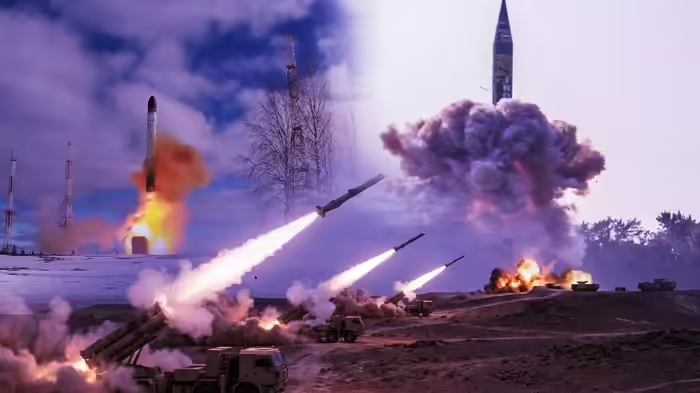
From intercontinental ballistic missiles (ICBMs) to hypersonic glide vehicles, these weapons are designed to defeat detection and interception, making them among the most feared instruments of modern warfare. Below is a look at 10 of the world’s longest-range and most formidable missiles, widely regarded as extremely difficult—if not nearly impossible—to stop.
1. RS-28 Sarmat (Russia)
Russia’s RS-28 Sarmat is one of the most powerful ICBMs ever developed, designed to replace the aging R-36M. With a reported range of over 18,000 km and a launch weight exceeding 200 tonnes, it can strike targets across the globe. Capable of carrying multiple independently targetable re-entry vehicles (MIRVs) and hypersonic glide vehicles, Sarmat can approach targets via unconventional trajectories, including over the South Pole, bypassing traditional missile defence systems.
2. DF-41 (China)
China’s DF-41 is a road- and rail-mobile ICBM with an estimated range of 12,000–15,000 km. Designed to enhance China’s second-strike capability, it can reportedly carry up to 10 nuclear warheads aimed at different targets. Its mobility and counter-measure systems make pre-emptive interception extremely challenging.
3. Trident II D5 (United States/United Kingdom)
The Trident II D5 is one of the most reliable strategic missile systems ever tested. Deployed on US Ohio-class and UK Vanguard-class submarines, it has a range of about 12,000 km. Continuous upgrades are expected to keep it operational until at least 2040, maintaining its role as a cornerstone of nuclear deterrence.
4. Agni-5 (India)
India’s Agni-5 is an indigenously developed, nuclear-capable long-range ballistic missile developed by the DRDO. Officially rated for a range of 5,000 km, several Western assessments suggest its actual reach may extend to 7,000–8,000 km. Recent upgrades include MIRV capability, significantly enhancing India’s strategic deterrence. The missile reportedly travels at speeds approaching Mach 24.
5. Avangard Hypersonic Glide Vehicle (Russia)
Russia’s Avangard represents a major breakthrough in hypersonic warfare. Launched atop a ballistic missile, it detaches and glides through the atmosphere at hypersonic speeds, carrying enormous kinetic energy. With a range of around 6,000 km, Avangard’s maneuverability makes interception by existing defence systems extremely difficult.
6. DF-17 (China)
China’s DF-17 is the world’s first operational missile system designed specifically for a hypersonic glide vehicle. With a range of approximately 2,500 km, it is tailored for regional strike missions and poses significant challenges to conventional missile defence due to its unpredictable flight path.
7. Kh-47M2 Kinzhal (Russia)
The Kinzhal is an air-launched ballistic missile, deployed from MiG-31 fighter aircraft. Capable of reaching speeds beyond Mach 10, it follows a highly maneuverable trajectory. With an operational range exceeding 2,000 km, it has been used in the Ukraine conflict, where interception attempts reportedly failed.
8. 3M22 Zircon (Russia)
Powered by a scramjet engine, the Zircon is a hypersonic cruise missile capable of sustaining speeds of around Mach 9 throughout its atmospheric flight. With an estimated range of 1,000 km, it represents a new class of continuously hypersonic weapons, widely considered beyond the reach of current air-defence systems.
9. Long-Range Hypersonic Weapon – “Dark Eagle” (United States)
The US Army’s Dark Eagle is America’s first land-based hypersonic weapon, using a common hypersonic glide body launched by a rocket booster. With a projected range of about 2,700 km, it remains under evaluation, as the US continues to refine its hypersonic capabilities.
10. Hwasong-18 (North Korea)
North Korea’s Hwasong-18 is its first solid-fuel ICBM, allowing rapid launch with minimal preparation time. Pyongyang claims a range of up to 15,000 km, theoretically capable of reaching the US mainland. However, due to limited independent verification, its exact capabilities remain uncertain.
Changing Face of Warfare
In addition to these systems, missiles such as Pakistan’s Shaheen, Iran’s Kheibar, and the US Minuteman III also remain critical components of global arsenals. As hypersonic and long-range missile technologies proliferate, traditional missile defence systems face growing challenges—prompting massive investments, such as the US proposal for advanced shield systems.
Experts warn that these weapons are not just tools of war, but instruments that could redefine deterrence, escalation and global security in the decades ahead.
Discover more from SD NEWS agency
Subscribe to get the latest posts sent to your email.