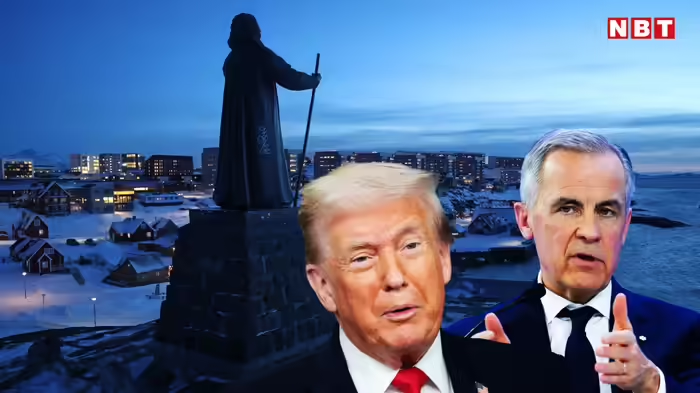
Ottawa/Davos: Since the beginning of his second term, U.S. President Donald Trump has increasingly targeted Canada, repeatedly referring to it as America’s “51st state.” In response, Canadian Prime Minister Mark Carney has taken a firm stance against U.S. pressure, including a diplomatic visit to China this month.
On Tuesday, Trump posted a map on social media depicting Canada, Greenland, and Venezuela as part of the United States. While the map was digitally edited, the message sent shockwaves across Canada: after Greenland, Canada could be next. Trump’s statements have sparked widespread anger among Canadians, who are now mobilizing to strengthen national resilience against potential U.S. threats.
Prime Minister Carney has warned that powerful nations are increasingly using economic integration, tariffs, and supply chains as instruments of pressure and coercion. Speaking at the World Economic Forum in Davos, Carney avoided explicitly naming the U.S., but described a “global breakdown” and urged middle powers to collaborate. “If we are not at the table, we will be on the menu,” he said, signaling a growing recognition among Canada and European nations of the risks posed by unchecked U.S. dominance.
Strengthening Borders and Arctic Defense
Canada has already spent nearly $1 billion to reinforce its southern border and plans to invest billions more to secure its northern frontier in the coming years. Carney reaffirmed that Canada stands firmly with Greenland and supports its right to determine its future. At the same time, he noted that Russia remains the primary security threat in the Arctic region.
To enhance Arctic security, Canada is collaborating with NATO allies, including eight Nordic-Baltic nations, to secure northern and western borders. Investments include over-the-horizon radar systems, submarines, aircraft, and troops trained for operations in ice-covered terrain. Carney also pledged more than $4 billion to expand early-warning radar coverage in the Arctic and increase a sustained military presence in the region.
Canada faces a unique challenge: it shares the world’s longest land border with the United States while also maintaining the largest maritime boundary with Greenland. Greenland holds strategic importance for both Canada and the U.S. For decades, Canada has worked with NATO and NORAD (North American Aerospace Defense Command) to develop operational defense plans for Greenland, including a NORAD mission scheduled this week. NORAD confirmed that aircraft operating from U.S. and Canadian bases will support long-planned activities in Greenland, reflecting ongoing defense cooperation between the U.S., Canada, and the Kingdom of Denmark.
Although Canadian authorities have yet to decide whether to deploy troops to Greenland, Carney’s speech at Davos signaled that relations with Trump’s administration are likely to remain tense. Canada has also sent a strong message to Washington during Carney’s China visit: it has alternative options and is prepared to protect its sovereignty. If Trump escalates further, the U.S. risks straining relations with its northern neighbor.
Discover more from SD NEWS agency
Subscribe to get the latest posts sent to your email.