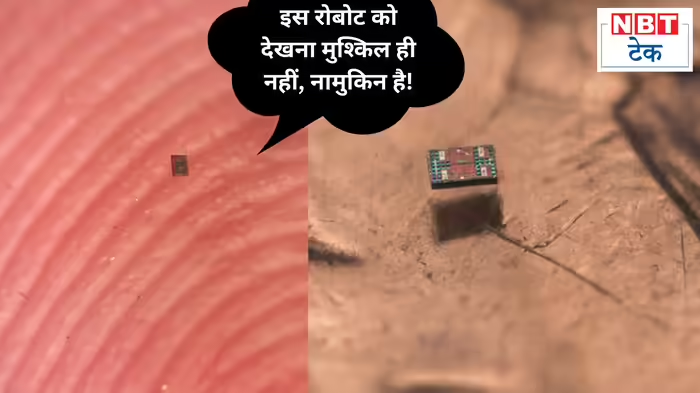
Researchers have created the world’s smallest autonomous robot, a breakthrough in robotics and nanotechnology. Despite being so tiny that it can only be seen under a microscope—roughly the size of a human cell—these robots are fully functional, with integrated solar panels and computing hardware. Each robot costs approximately 1 US cent, or around 83 paise in Indian currency.
A Milestone in Robotics
Developed collaboratively by scientists from the University of Pennsylvania and the University of Michigan, these miniature robots are programmable and operate autonomously, marking a significant advancement over traditional robots. According to research published in Science Robotics and the Proceedings of the National Academy of Sciences (PNAS), the robots can sense their environment, respond to changes, and operate continuously for months despite their microscopic size.
How They Work
The robots are capable of detecting temperature changes and adjusting their direction accordingly. They are equipped with extremely small solar panels, generating only 75 nanowatts of power—about 100,000 times less than a smartwatch—but enough to run their specialized low-voltage circuits. These include a complete computing system with processor, memory, and sensors, all packed into a space too small to see with the naked eye.
Applications
These robots are designed primarily for biomedical purposes, such as monitoring cells and assisting in medical technology development. In the future, they could be integrated into micro-devices or advanced medical tools, opening new possibilities in nanorobotics and healthcare.
Significance for the Future
According to Mark Miskin, one of the lead researchers, this achievement represents a major step in the field of robotics. For decades, scientists have struggled to create robots smaller than 1 millimeter that are fully autonomous. This research demonstrates how computing hardware, sensors, and motors can be miniaturized to an unprecedented scale, paving the way for even more advanced micro-robots capable of operating in challenging environments.
Discover more from SD NEWS agency
Subscribe to get the latest posts sent to your email.