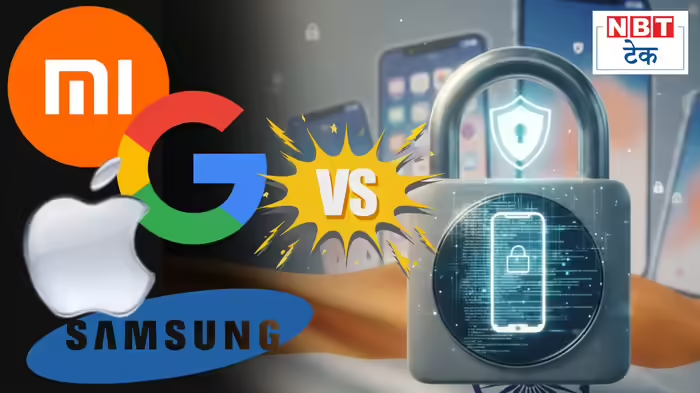
New Delhi: A recent Reuters report has reignited a global debate over smartphone source code, often described as the “digital key” to modern devices. Although the Indian government later rejected claims that it had demanded access to companies’ source codes, the controversy has exposed a deeper and unresolved conflict between state security concerns and corporate secrecy.
The episode has raised a fundamental question: What exactly is source code, and why are smartphone companies so reluctant to share it with governments?
What Is Source Code and Why Does It Matter?
Source code is the basic set of instructions that tells a software or application how to function. Written in programming languages such as Java, Python, or C++, it can be compared to a recipe that determines how a dish is prepared.
In the context of smartphones, source code decides how the operating system works, how apps interact, and how securely user data is stored. For this reason, it is often called the “brain” of a device. Any weakness in the code can expose phones to hacking, data theft, or surveillance.
This is precisely why technology companies treat their source code as a closely guarded trade secret.
The Government’s Perspective
According to the Reuters report, the Indian government was considering introducing 83 new security standards aimed at protecting citizens’ data and curbing the sharp rise in online fraud and cybercrime. One of these proposed standards allegedly involved examining smartphone source code to identify vulnerabilities that could compromise user privacy.
While the government later denied seeking such access, officials globally argue that code audits can help detect security loopholes, strengthen consumer protection, and prevent large-scale digital fraud. Similar demands have previously been raised by governments in countries such as the United States and China.
Why Companies Are Pushing Back
Smartphone manufacturers strongly oppose sharing their source code, citing multiple risks:
- Security threats: If source code leaks, hackers could exploit vulnerabilities and launch large-scale cyberattacks.
- Commercial risks: Competitors could copy proprietary technology, undermining innovation and market advantage.
- User privacy concerns: Giving deep-level access to software could expose sensitive user data, raising fears of surveillance or misuse.
From the companies’ standpoint, handing over source code is equivalent to giving away the master key to their entire digital ecosystem.
A Conflict Likely to Intensify
NBT View: While the immediate controversy may have cooled after official clarifications, experts believe the challenge will only grow in the age of Artificial Intelligence. Many AI systems operate as so-called “black boxes,” where even developers struggle to fully explain how decisions are made.
One possible solution could be independent third-party audits, where neutral experts examine code without compromising corporate secrets or user privacy. However, designing such a framework will be difficult. The real challenge lies in striking a balance—protecting citizens from cyber threats while safeguarding innovation, business interests, and personal privacy.
As smartphones become ever more central to daily life, the battle over the “digital key” is far from over—and its outcome could shape the future of digital governance worldwide.
Discover more from SD NEWS agency
Subscribe to get the latest posts sent to your email.