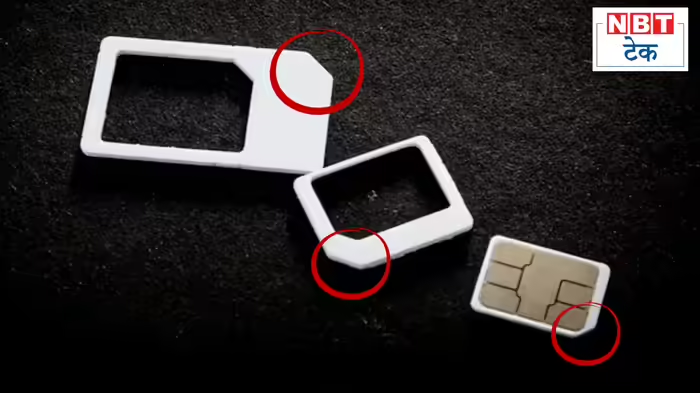
Have you ever closely looked at a SIM card? No matter which country it comes from, every SIM card has one corner cut at an angle. At first glance, it may seem like a simple design choice—but in reality, this small cut plays a crucial role in protecting your phone and ensuring reliable communication.
Interestingly, SIM cards were once perfectly square. So what changed, and why did the cut corner become a global standard? Let’s understand the science and logic behind it.
The Evolution of SIM Card Design
The journey of the SIM (Subscriber Identity Module) card began in the early 1990s. In its earliest form, a SIM card was as large as a credit card. As mobile phones became smaller and more compact, SIM cards evolved too—shrinking from full-size SIMs to mini, micro, and finally nano SIMs.
Despite these changes in size, one design element remained constant: the cut corner. The European Telecommunications Standards Institute (ETSI) adopted this feature as a universal standard to ensure consistency across countries and devices. Over time, it proved to be not only simple but highly effective.
Why Is One Corner Cut?
The primary reason for the cut corner is correct orientation. Every SIM card has a delicate golden chip at its center, which must align precisely with the phone’s SIM reader. If a SIM card is inserted in the wrong direction, it can damage both the chip and the phone’s internal SIM reader.
The angled corner acts as a physical guide, ensuring that users insert the SIM card correctly every time. This reduces errors, prevents hardware damage, and ensures smooth connectivity. That’s why all SIM formats—mini, micro, or nano—feature the same cut corner.
Benefits for Smartphone Manufacturers
The cut corner doesn’t just help users; it also benefits device manufacturers. Smartphone companies design SIM trays and internal slots based on this standardized shape. As a result, during manufacturing and assembly, there is minimal risk of incorrect placement or design mismatch.
This global standard ensures that a SIM card can be inserted correctly into any compatible phone, anywhere in the world.
Will eSIM Make Cut SIM Cards Obsolete?
With the rise of eSIM technology, the era of physical SIM cards may gradually come to an end. Many modern smartphones now support eSIMs, and some—especially from Apple—offer eSIM-only models.
An eSIM is digitally embedded into the device and activated through software, eliminating the need for a physical card altogether. As this technology becomes more widely adopted, traditional SIM cards—with their iconic cut corners—may eventually disappear.
The Takeaway
That tiny cut on your SIM card is not about looks—it’s about precision, safety, and global compatibility. It’s a small design choice with a big impact, silently protecting your phone for decades. As technology moves toward a digital future with eSIMs, this humble feature may soon become a thing of the past—but for now, it remains an essential part of mobile communication.
Discover more from SD NEWS agency
Subscribe to get the latest posts sent to your email.