
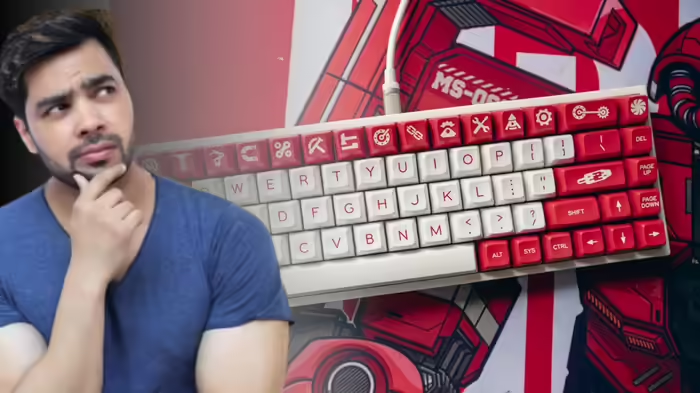
Have you ever wondered why keyboard letters are not arranged in alphabetical order? Contrary to popular belief, the arrangement is not meant to speed up typing. In fact, the design of modern keyboards dates back to the mechanical limitations of early typewriters, and it was created to slow typing speed to prevent jams.
The Problem with Early Typewriters
In the 1870s, the first typewriters had keys arranged as ABCDE in a row. These machines were entirely mechanical, and rapid typing often caused the typebars to jam. The repeated stoppages delayed work and reduced efficiency.
Enter the QWERTY Layout
To solve this problem, Christopher Latham Sholes introduced the QWERTY layout. He strategically placed the most frequently used letters, such as E, T, A, and I, far apart from each other. This forced typists’ fingers to travel longer distances, slowing down typing just enough to prevent mechanical jams. Over time, this arrangement became standard and was named QWERTY.
Why Hasn’t It Changed?
With modern technology, keyboards no longer face the mechanical issues of the past, and a straightforward ABCDE layout could technically be used. However, global familiarity and muscle memory have made the QWERTY layout virtually irreplaceable. Switching now would disrupt typing speeds for millions of people worldwide.
So, the next time you glance at a keyboard, remember: it’s intentionally designed to slow you down… in the name of efficiency!
Discover more from SD NEWS agency
Subscribe to get the latest posts sent to your email.