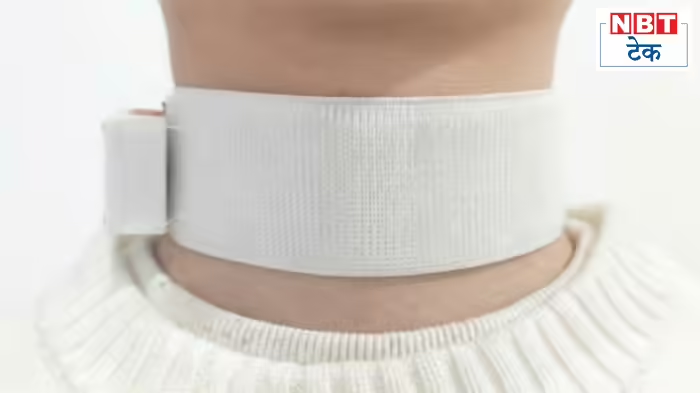
In a major breakthrough for stroke rehabilitation, scientists at the University of Cambridge have developed an innovative AI-powered wearable collar called ‘Revoice’, designed to help stroke patients regain their ability to speak—without the need for surgery or brain implants. The device interprets subtle speech signals and emotions, reconstructing full sentences from fragmented sounds, and offers patients a renewed sense of voice and independence.
A New Voice Without Surgery
Stroke often leaves patients struggling with dysarthria, a common condition that affects speech clarity and control. While many patients can speak after repeated practice, everyday conversation remains a challenge. Existing speech-assistance technologies are either ineffective or require invasive brain implants.
Addressing this gap, the Revoice collar offers a non-invasive, portable solution. According to Professor Luigi Occhipinti from Cambridge University’s Department of Engineering, most stroke patients gradually regain some or all of their natural voice, making implants unnecessary. What they truly need, he explains, is an accessible and wearable speech-support system—and Revoice aims to fill that need.
How the Revoice Device Works
Worn around the neck like a collar, Revoice uses highly sensitive sensors to detect micro-vibrations from the throat that occur when a person attempts to speak. These signals are then processed using artificial intelligence to reconstruct complete, meaningful sentences.
The device also analyzes pulse-based signals to assess the user’s emotional state, allowing it to generate speech that better reflects tone and intent. In a trial involving five stroke patients with dysarthria, Revoice reduced sentence-level speech errors to just 2.9 percent, a significant improvement over existing solutions.
Powered by Advanced AI and Language Models
Revoice is equipped with a Large Language Model (LLM)—similar to the technology used in AI systems like ChatGPT—which helps predict and reconstruct entire sentences from partial speech inputs. This enables smoother, more natural communication and makes the device far more advanced than traditional speech aids.
Researchers believe this technology could eventually be extended to patients suffering from Parkinson’s disease, motor neuron disease, and other neurological conditions that affect speech.
Clinical Trials Still Needed
Despite its promise, experts stress that large-scale clinical trials are essential before Revoice can be made widely available. Professor Occhipinti notes that stroke patients often experience deep frustration—they know exactly what they want to say, but damaged neural pathways prevent their thoughts from reaching their voice. Revoice aims to bridge that gap.
The long-term goal is to develop a multilingual, emotion-aware device capable of adapting to different languages and speech patterns.
A Breakthrough Backed by Science
The research behind Revoice has been published in the prestigious journal Nature Communications, underscoring its scientific credibility and potential global impact.
Conclusion
Revoice represents a powerful step forward in assistive technology—one that could restore not just speech, but dignity and confidence to millions of stroke survivors worldwide. As research progresses, this AI-driven wearable may redefine how neurological speech disorders are treated in the future.
Discover more from SD NEWS agency
Subscribe to get the latest posts sent to your email.