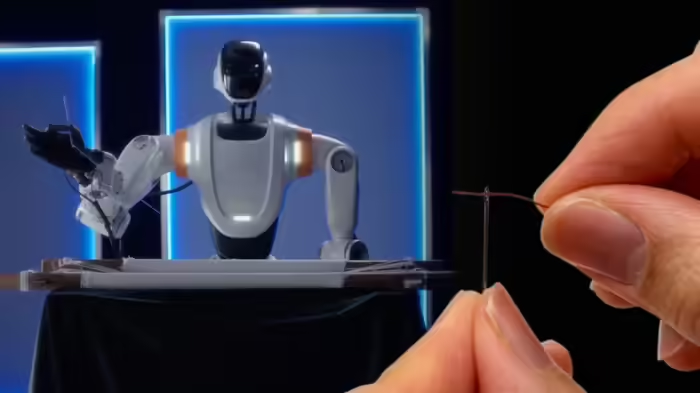
While the future of AI and robotics taking over major jobs was already anticipated, a Chinese company has now unveiled humanoid robots capable of performing delicate tasks like embroidery. TARS Robotics recently showcased their robots in a live demonstration, where they performed intricate sewing tasks, including threading a needle—an activity that even requires patience and precision from humans. Let’s explore the capabilities of these advanced humanoid robots.
Robots Take on Stitching and Embroidery
TARS Robotics has achieved a significant milestone in the world of robotics. Their humanoid robots can now perform hand embroidery with remarkable precision. According to a report by Interesting Engineering, the company demonstrated how their robots can accurately thread needles and carry out fine stitching. This is a remarkable achievement because such delicate tasks demand steady hands, precise control, and patience—skills traditionally exclusive to humans.
Why Embroidery by Robots Is a Big Deal
Although hand embroidery might seem simple, achieving this with robots is extraordinary. The task requires fine motor coordination, appropriate pressure, and synchronization of movements. Additionally, materials like fabric and threads vary in texture and size, making errors like broken threads or torn fabrics a high risk. During the live demo, TARS Robotics successfully performed these tasks flawlessly, showcasing their robots’ precision.
The Fusion of Physics, Data, and AI
Dr. Chen Yilun, CEO of TARS Robotics, explained that this feat was made possible through the integration of physics, data, and AI. Initially, data was collected from real-world human activities. AI models then learned from this data, which was ultimately applied to the robots. The company’s SenseHub platform gathers data on how humans perform tasks, which trains the AWE 2.0 AI model. This model bridges the gap between the digital and physical world, enabling robots to handle delicate tasks.
Robots Will Do More Than Just Embroidery
TARS Robotics does not intend to limit their robots to embroidery. The company views embroidery as a demonstration of the robots’ ability to handle delicate and complex tasks. Future applications include assembling intricate electrical components, handling soft materials, and performing wire harness assembly, all powered by increasingly capable AI models.
A Year of Rapid Progress
Founded on February 5 of this year, TARS Robotics has transformed its innovative ideas into working humanoid robots in less than a year. The live demonstrations impressed audiences and investors alike, leading to strong financial backing. The company has raised $120 million in an angel round, followed by $122 million in an angel-plus round, which will accelerate research, development, and large-scale deployment of robots.
With this pace of innovation, robots may soon handle almost any task with ease, challenging the role of humans in precise, skilled work.
Discover more from SD NEWS agency
Subscribe to get the latest posts sent to your email.