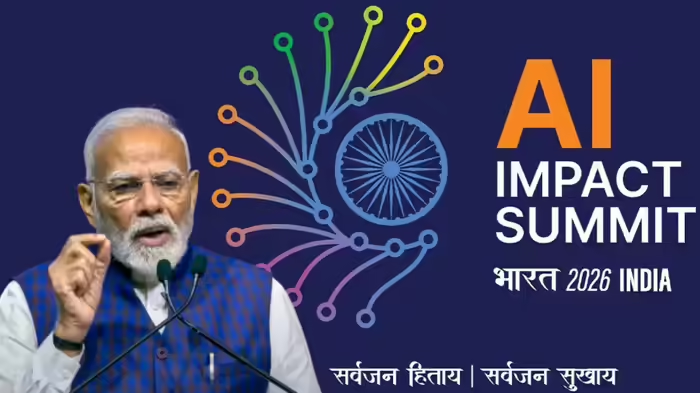
At the India AI Impact Summit 2026, Prime Minister Narendra Modi outlined India’s vision for AI, emphasizing that artificial intelligence is not a threat to the IT sector but a tool to amplify human potential. He projected that by 2030, India’s IT sector could reach $400 billion, driven in part by AI innovations.
AI to Bridge Gaps in Health, Agriculture, and Education
PM Modi highlighted that India is leveraging AI to reduce inequalities in critical sectors. In healthcare, AI is being used for early detection of diseases like tuberculosis, diabetic retinopathy, and epilepsy. In education, AI-powered platforms assist children in learning in their regional languages. AI is also helping digitize and preserve ancient manuscripts. While global concerns focus on AI increasing inequality, India is actively using AI to narrow social and economic gaps.
Addressing Bias and Inclusivity in AI
The Prime Minister acknowledged concerns about AI bias. He stressed that if AI relies solely on English or urban data, it may fail to serve rural populations and speakers of regional languages. To address this, India is emphasizing diverse, localized data and encouraging research by institutions and tech companies.
Integrating AI with India’s Digital Infrastructure
Drawing lessons from Aadhaar and UPI, PM Modi noted that India’s digital infrastructure was built for public welfare, not private gain. By linking AI to this framework, government schemes can become more efficient and transparent, while data security and strong regulations remain a priority. The aim is to ensure AI benefits reach everyone—from rural farmers to small business owners and women entrepreneurs.
Nurturing AI Talent and Innovation
India possesses vast talent and energy. PM Modi emphasized that the country should not only use AI but also develop and innovate AI technologies. The 2026–27 budget boosts data centers and cloud infrastructure, while the IndiaAI framework supports startups and research institutions with high-performance computing. Investments are also being made in semiconductors, AI Centers of Excellence, and digital skilling, positioning India to shape the global AI revolution.
AI and the Future of IT
AI is expected to transform, not replace, the IT sector. IndiaAI Mission has established four Centers of Excellence in healthcare, agriculture, education, and smart cities, along with five skill development centers. The vision is for India to not only provide AI services but also build products and platforms for global markets.
Ensuring AI Safety and Ethical Use
PM Modi underlined that AI’s impact depends on human intent. India has launched the IndiaAI Safety Institute and implemented regulations to tackle deepfakes and misinformation, alongside the Digital Personal Data Protection Act. The goal is to balance innovation with safety.
AI in an Atmanirbhar Bharat
For a self-reliant India, PM Modi emphasized that the country must develop its own AI capabilities, aiming to be among the top three AI nations globally. India seeks to ensure that AI models developed domestically are used worldwide, startups scale globally, and every citizen views AI as an opportunity, not a threat. The IndiaAI Mission strives to ensure AI serves the nation’s values, citizens, and long-term development goals.
Discover more from SD NEWS agency
Subscribe to get the latest posts sent to your email.