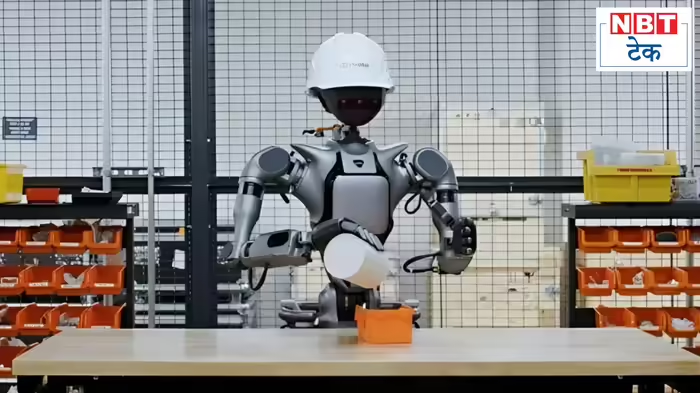
Robots are getting smarter, and the day is not far when they will be able to think, plan, and predict the consequences of their actions—much like humans. NVIDIA has introduced Cosmos Policy, a breakthrough framework that enables this capability for robots.
What is Cosmos Policy?
In robotics, a “policy” acts as the brain of a robot, translating sensor data and camera inputs into actionable decisions. Traditional robot policies rely on task-specific neural networks, often requiring extensive labeled data and manual tuning for each environment. Cosmos Policy, however, leverages NVIDIA’s large-scale video world models, known as Cosmos Predict, to train robots in a more generalized and data-efficient way.
Instead of building a control model from scratch, Cosmos Policy post-trains pre-learned video models on demonstration data. This allows the robot to understand how the physical world evolves over time and predict the outcomes of its actions. The framework combines action selection, future state prediction, and task success estimation in a single architecture—eliminating the need for multiple specialized models.
Strategic, Data-Efficient Planning
Benchmarks indicate that Cosmos Policy excels in multi-step robotic tasks requiring long-term planning. In some cases, it outperforms existing methods while using significantly fewer demonstrations. By leveraging pre-existing knowledge from large video models, Cosmos Policy reduces the amount of real-world training data needed, which is costly and time-consuming to collect.
A key advantage of Cosmos Policy is its ability to plan multiple potential action sequences and evaluate their expected outcomes and rewards. This allows robots to act strategically rather than just reactively, making them more effective in complex environments.
A Milestone in Robotics
With Cosmos Policy, robots will no longer just follow pre-programmed instructions. They will think, plan, and make informed decisions, learning from observations of the world—similar to how humans learn by watching and interacting with their surroundings. This development marks a significant leap toward truly intelligent robotics.
Discover more from SD NEWS agency
Subscribe to get the latest posts sent to your email.