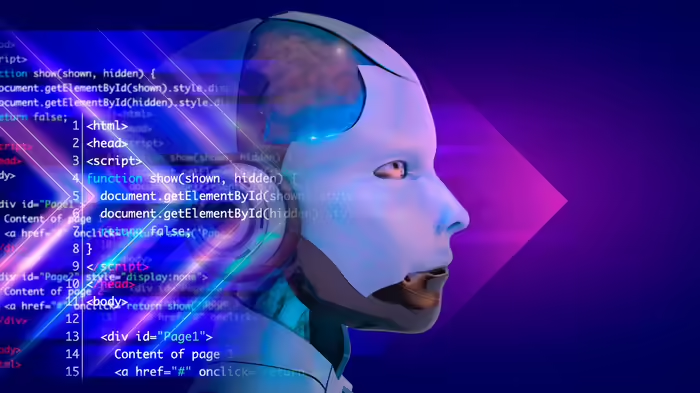
Meta, the owner of Facebook, has introduced a groundbreaking AI system that is capable of teaching itself to code. This system, developed by Meta’s Fundamental AI Research department, can autonomously generate code, introduce bugs into it, and then fix those bugs — all without human intervention or reliance on data from platforms like GitHub. This innovation marks a significant milestone in the evolution of artificial intelligence and software development.
The Significance of the Research:
The aim of this research is to create an AI that can function as a software engineer without any human assistance. This could drastically improve the software development process, making it faster and more accurate. In the future, AI-driven systems could autonomously handle tasks like bug fixing, testing, and debugging, enabling companies to build self-learning agents at scale.
This research was carried out in collaboration with experts from the University of Illinois Urbana and Carnegie Mellon University. If successful, it could have a profound impact on both programming education and the software industry, as AI would become capable of writing and improving code as a fundamental skill.
How the SSR System Works:
The Self-Play SWE-RL (SSR) system relies on a large language model (LLM) that plays two distinct roles: one as a ‘bug injector’ and the other as a ‘bug solver’. When acting as a bug injector, the model intentionally introduces errors into the code — such as deleting a line, altering logic, or repeating old changes. In its role as a bug solver, the model then identifies these mistakes and corrects the code. By repeatedly going through this process, the AI learns new coding patterns and solutions on its own.
The entire training process takes place within open-source repositories and Docker sandbox environments, allowing the AI to experiment safely and learn from real codebases without compromising the system’s integrity. Open-source repositories are publicly accessible code stores, while Docker sandbox environments provide isolated spaces to run code safely without affecting the underlying system.
A Shift from Traditional AI Systems:
Traditionally, AI coding agents have been trained on data written by humans. These systems were limited by the examples they were trained on. SSR, however, eliminates this dependency. Instead of relying on pre-existing data, SSR seeks out new problems and solves them autonomously, expanding its own capabilities without human input.
Meta claims that the SSR system has outperformed previous models on well-known benchmarks such as SWE-Bench Verified and SWE-Bench Pro. In the Verified test, SSR scored 10.4 points higher than the previous best-performing system, and in the Pro test, it was 7.8 points ahead. These results surpass those achieved by models that were trained on large-scale human-generated data.
In conclusion, Meta’s new AI system could be a game-changer in the field of software development. By allowing AI to autonomously learn and improve its coding skills, it could dramatically accelerate development cycles and reshape the role of human software engineers in the future.
Discover more from SD NEWS agency
Subscribe to get the latest posts sent to your email.