
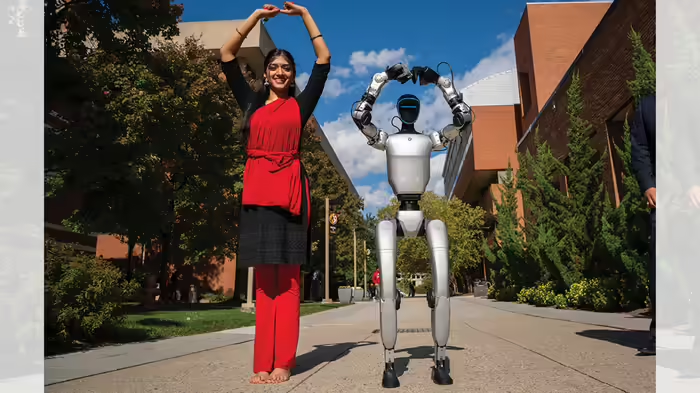
Indian culture has long been admired for its depth, discipline, and expressiveness. But few could have imagined that an ancient classical dance form would one day help robots learn how to move their hands like humans. In a fascinating blend of tradition and technology, researchers in the United States have found that Bharatanatyam, one of India’s oldest classical dances, holds the key to improving robotic hand movements.
Scientists at the University of Maryland, Baltimore County (UMBC) have developed a new training framework for robots after closely studying the hand gestures—known as mudras—used in Bharatanatyam. Their findings reveal that these structured, meaningful gestures can significantly enhance how robots learn and replicate complex human hand motions.
Why Hand Movements Matter
Hand movements are a crucial part of human body language. We use them to emphasize points, express emotions, and sometimes communicate entire ideas, as in sign language. The human hand itself is remarkably complex, with more than 20 joints, yet the brain controls these movements effortlessly and at high speed.
Understanding how the brain manages such complexity has long been a challenge for scientists—especially those working on robotics. This is where Bharatanatyam enters the picture.
The Research Behind the Discovery
The UMBC research team, led by Professor Ramana Vinjamuri, published their study in the scientific journal Scientific Reports. The goal was to understand how the human brain simplifies and controls intricate hand movements—and how this understanding could be applied to robotics.
The researchers analyzed hand gestures from Bharatanatyam because each mudra carries a clear, predefined meaning and follows precise, controlled movements. These gestures are not only visually elegant but also biomechanically efficient.
What Makes Bharatanatyam Mudras Special?
When compared to everyday hand movements, Bharatanatyam mudras were found to rely on a limited set of basic motion patterns, combined in different ways. This makes them ideal for creating a structured training system for robots.
The researchers discovered that these dance gestures are more balanced, controlled, and repeatable than many daily-use hand movements. As a result, they provide a cleaner and more effective blueprint for teaching robotic hands.
How the Brain Controls the Hands
One of the most important findings of the study is that the human brain does not control each finger independently. Instead, it uses coordinated movement groups called “synergies.” Just as letters combine to form words, multiple synergies come together to create complex hand gestures.
The team recorded 75 different hand poses, including Bharatanatyam mudras, everyday grasping actions, and sign language gestures. The results showed that synergies derived from dance gestures were especially powerful—they could reproduce other types of gestures with greater accuracy.
Training Robots with Dance Principles
Using these movement synergies, researchers trained robots without forcing them to memorize every individual hand position. Instead, robots learned how to combine basic movements intelligently. This allowed robotic hands to create new gestures using less data, making learning more efficient.
With this method, robots found it easier to perform tasks such as sign language communication and object manipulation—key skills for human-robot interaction.
Beyond Robotics: A Broader Impact
Professor Vinjamuri believes this research could have far-reaching implications. In the future, robots may be able to perform human-like tasks with greater precision and adaptability. Beyond robotics, the same principles could also be applied to hand rehabilitation therapy, helping patients relearn hand movements after injury or illness.
From temple stages to research labs, Bharatanatyam has once again proven its timeless relevance—this time, by shaping the future of robotics and human-machine interaction.
Discover more from SD NEWS agency
Subscribe to get the latest posts sent to your email.