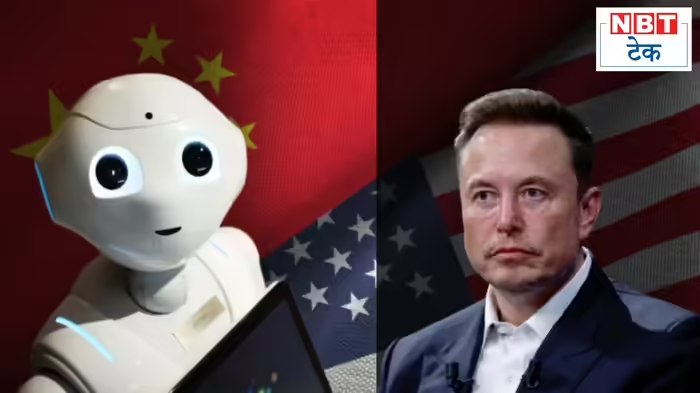
Las Vegas: Tesla CEO Elon Musk has expressed growing concern over China’s dominance in the humanoid robotics sector, a worry that was further fueled by innovations displayed at CES 2026. During a conference call in April 2025, Musk warned that the U.S. could fall behind in the global race for humanoid robots due to affordable, mass-produced Chinese models.
Chinese Companies Lead the Way
At CES 2026, Chinese robotics firms showcased a wide range of humanoid robots performing tasks such as table tennis, floor cleaning, and kung fu practice. Musk, while acknowledging the performance edge of Tesla’s Optimus robots, noted that he feared the leaderboard from ranks 2 to 10 would be dominated by Chinese companies.
One standout company, AgiBot, introduced its next-generation simulation platform, Genie Sim 3.0, based on Nvidia Isaac Sim. This platform allows robots to train and test in highly realistic virtual environments, reducing time and costs while enabling easier skill transfer to real-world applications.
Like many other Chinese firms, AgiBot plans to expand internationally, targeting markets like Japan, which faces labor shortages, and using humanoid robots for promotional and entertainment purposes in countries including the U.S.
Competitive Pricing and Mass Production
Chinese robots are also priced significantly lower than U.S. counterparts, posing a serious challenge to American manufacturers. For instance:
- Unitree offers entry-level humanoid robots for $6,000 (~₹5.34 lakh).
- AgiBot sells smaller models for $14,000 (~₹12.63 lakh).
- In comparison, Tesla’s Optimus humanoid robots are priced at around $30,000 (~₹27.08 lakh).
Musk’s concern stems from China’s large-scale manufacturing capability and lower costs, which allow Chinese firms to dominate both domestic and international markets.
AI-Powered Self-Learning Robots
Chinese startups like EngineAI, Unitree, AgiBot, and Galbot are leveraging artificial intelligence (AI) to enable humanoid robots to learn new tasks autonomously. According to research firm Omdia, most of the 13,000 humanoid robots shipped worldwide last year were manufactured by Chinese companies, outnumbering robots from U.S. firms such as Tesla and Figure AI.
Analysts predict that by 2035, global humanoid robot shipments could reach 2.6 million units, fueled by AI models and self-reinforcement learning, making robots increasingly capable of industrial, service, and domestic tasks.
Discover more from SD NEWS agency
Subscribe to get the latest posts sent to your email.