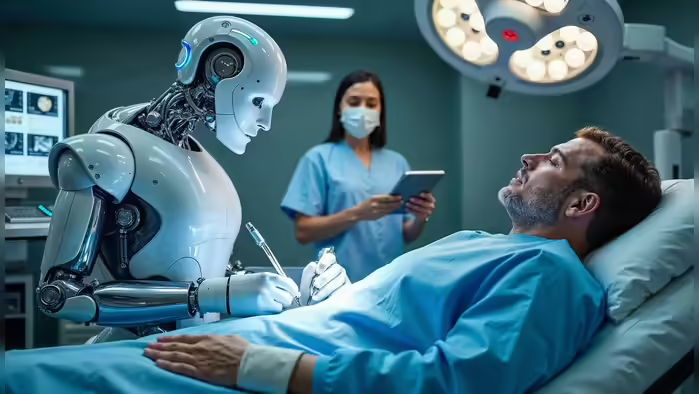
New York / San Francisco: Tesla CEO Elon Musk has once again made headlines with a bold claim, stating that the company’s Optimus humanoid robot will surpass the world’s best surgeons within the next three years. Musk made these remarks during a conversation on the Moonshots podcast with host Peter Diamandis, emphasizing the potential of robots to address the global shortage of skilled surgeons.
Robots to Perform Surgeries on a Massive Scale
Musk highlighted that training human doctors takes years, their time is limited, and mistakes are inevitable. “Within three years, Optimus robots will be available on such a large scale that their numbers will exceed the total number of surgeons on Earth, and they will perform surgeries better than human doctors,” Musk said. He further asserted that the humanoid robot could handle surgeries at a level currently achieved only by top-tier professionals.
The CEO first showcased the Optimus prototype in 2022, promising that production models would be ready by the following year. However, in 2024, Musk revised the target for commercial availability to 2026, citing technical and production advancements.
Expert Skepticism
Despite Musk’s optimism, experts remain cautious. Professor Arthur Caplan, a bioethicist at the Grossman School of Medicine, New York University, questioned the feasibility of Musk’s claim. “It is highly unlikely that a robot will be able to perform all types of complex surgeries—such as cardiac, brain, orthopedic, plastic, and pediatric surgeries—better than humans within three years,” he said.
Caplan explained that the human variability in anatomy and surgical conditions makes precise programming extremely challenging. He also noted that it could take years of comparative studies to validate whether robotic outcomes consistently match or surpass those of experienced surgeons.
Implications for Healthcare
Musk’s statement underscores Tesla’s ambition to integrate AI and robotics into high-stakes human tasks, including medical procedures, which could potentially revolutionize healthcare delivery if realized. However, significant technological and ethical hurdles remain before robots can safely perform complex surgeries at scale.
Discover more from SD NEWS agency
Subscribe to get the latest posts sent to your email.