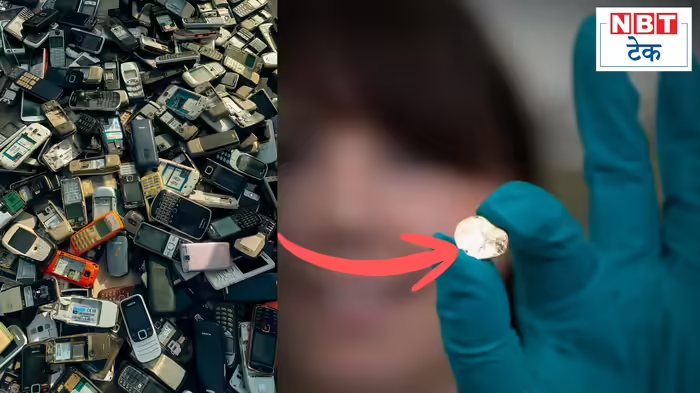
In a groundbreaking development, Chinese researchers have unveiled a new, cost-effective method to extract gold from electronic waste, capable of recovering nearly 98% of gold from old mobile phones in just 20 minutes. Unlike conventional methods that rely on toxic chemicals like cyanide, this innovative process is safer for both humans and the environment.
Faster, Cheaper, and Greener Extraction
The research, conducted by the Guangzhou Institute of Energy Conversion and the South China University of Technology under the Chinese Academy of Sciences, allows gold recovery at room temperature in a fraction of the time required by traditional techniques. The process costs about one-third of conventional methods, making it the most economical method to date. Using this technique, gold can be extracted from the CPUs of old mobile phones and PCBs of household electronics with a remarkable 98.2% efficiency, while palladium recovery reaches 93.4%.
How the Process Works
The technique uses a self-catalytic leaching mechanism and requires no corrosive reagents or external catalysts. Instead, it employs a simple solution of potassium peroxymonosulfate (PMS) and potassium chloride (KCl). When applied to the surface of gold or palladium, the metals themselves act as catalysts. Reactive oxidants such as singlet oxygen and hypochlorous acid form on the metal’s surface, breaking down the metal atoms. The chloride ions then bind with these atoms, allowing them to dissolve into the solution for easy extraction.
High Efficiency and Low Cost
Testing through quenching experiments and spectroscopic analysis confirmed the method’s effectiveness. Processing just 10 kilograms (22 pounds) of discarded circuit boards can yield approximately 1.4 grams of gold at a cost of only $72, equivalent to about $1,455 per ounce—well below current market prices. In addition to cost savings, the process consumes 62.5% less energy than traditional extraction methods.
Significance Amid Rising Gold Prices
With international gold prices recently surpassing $4,400 per ounce, and projections suggesting they could exceed $10,000 per ounce by the end of the decade, this technology represents a major breakthrough for sustainable and profitable e-waste recycling.
Addressing the Growing E-Waste Challenge
Electronic waste is among the fastest-growing types of waste globally. According to the World Health Organization (WHO), 2.6 million tons of e-waste are generated each year, with estimates suggesting this could reach 82 million tons by 2030. Items like computers, mobile phones, large household appliances, and medical devices contain small amounts of precious metals such as gold and palladium, valued for their excellent conductivity, stability, and corrosion resistance. Extracting these metals not only recycles valuable resources but also mitigates environmental hazards associated with discarded electronics.
This innovative method offers a faster, safer, and more sustainable path for recovering precious metals from e-waste, with the potential to revolutionize gold extraction worldwide.
Discover more from SD NEWS agency
Subscribe to get the latest posts sent to your email.