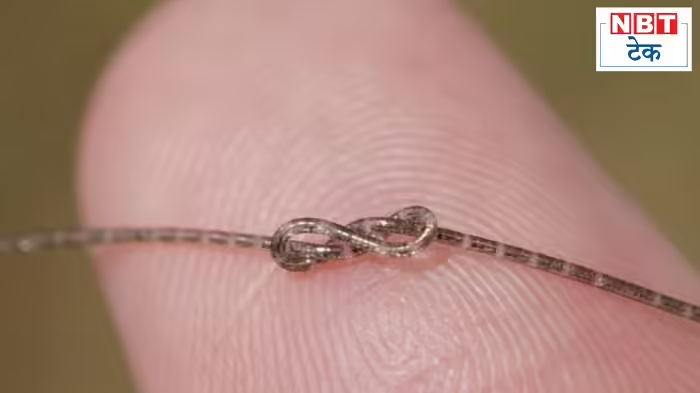
Chinese scientists have developed a flexible fiber chip as thin as a human hair. Remarkably, it can be stretched up to 30 inches and still function even after being crushed under a 15-ton truck. Despite its small size, each fiber contains thousands of electronic circuits, opening up possibilities for smart textiles that work like computers or displays, while remaining washable, soft, and stretchable.
A Decade of Research
According to SCMC reports, the team at Fudan University in Shanghai, led by Peng Huisheng, spent over 10 years developing this technology. Their goal was to move beyond rigid silicon chips and integrate computing systems directly into fibers instead of embedding them in clothes.
Powerful Computing in a Tiny Fiber
Each fiber chip contains 100,000 transistors per centimeter, comparable to the scale of large integrated circuits used in conventional computer processors. Current lab prototypes can perform essential computing tasks. Extending the fiber length increases its computational power, with one-meter fibers capable of holding millions of transistors, equivalent to a classical CPU. Future advancements using nanometer-scale photolithography could increase transistor density even further.
How the Fiber Chip Works
Traditionally, microchips are manufactured on rigid, flat surfaces. The Fudan team replaced these with flexible substrates, onto which entire electronic circuits were built. The substrate is then rolled like a thread to form a Fiber Integrated Circuit (FIC), with each fiber as thin as a human hair.
Unlike earlier fiber electronics that only conducted electricity or sensed signals, these new fibers function as microcomputer systems. Each thread contains resistors, capacitors, diodes, and transistors, capable of processing both digital and analog signals. The fibers are designed to withstand conditions where rigid chips would fail.
Durability and Flexibility
Testing showed that these FICs could be bent and twisted over 10,000 times, stretch up to 30%, and bend 180 degrees. They remained operational even after over 100 washes, at temperatures up to 100°C, and under the weight of a 15.6-ton truck. Each fiber can now integrate power supply, sensing, computing, and display functions, eliminating the need for bulky chips or wires in smart fabrics.
This breakthrough represents a significant step toward wearable computing and smart textiles, potentially transforming clothing into fully functional electronic systems while maintaining comfort and durability.
Discover more from SD NEWS agency
Subscribe to get the latest posts sent to your email.