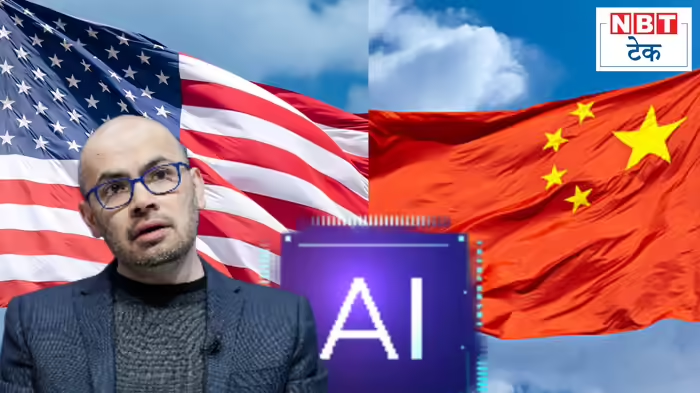
After Elon Musk, Google has acknowledged that China is rapidly catching up in the field of Artificial Intelligence (AI). According to Demis Hassabis, CEO of Google DeepMind, China’s AI models are only a few months behind those of the U.S. and other Western countries. This indicates that China could soon match or even surpass American capabilities in AI technology.
China’s Rapid Progress in AI
Speaking on CNBC’s podcast “The Tech Download”, Hassabis highlighted that China’s AI models have approached the performance levels of Western counterparts, perhaps much sooner than anticipated. He stated, “They may currently be just a few months behind. This means the capabilities of U.S. and Western AI models could be mirrored by Chinese models within a very short time.”
This assessment challenges the common perception that China is still far behind in AI. Earlier, Elon Musk had also warned that China is advancing rapidly in AI and robotics, urging the U.S. to remain cautious.
China’s AI Achievements So Far
About a year ago, China’s AI lab DeepSeek introduced a model that impressed global markets by performing efficiently with lower-cost chips. Major Chinese tech firms like Baidu, Tencent, Alibaba, and startups like Moonshot AI and Jipu have also developed highly capable AI models, signaling rapid growth and competition in the sector.
Can China Innovate Beyond Current Limits?
Hassabis cautioned that while China is catching up, its companies have yet to demonstrate the ability to make groundbreaking innovations in AI. He added, “The question is whether they can invent something entirely new beyond current boundaries. They’ve shown strong catching-up capabilities, but have they created something like a new transformer that pushes the frontier further? Not yet.”
The Importance of the Transformer
The transformer architecture, developed by Google researchers in 2017, underpins modern large language models, including OpenAI’s ChatGPT and Google’s Gemini. This technology remains central to the AI race, and leading innovators continue to leverage it for breakthroughs.
Global Context
NVIDIA CEO Jensen Huang also observed last year that the U.S. is not overwhelmingly ahead in the AI race. He noted that China leads in energy, maintains competitive infrastructure, and is quickly closing the gap in AI model development.
With Chinese tech firms accelerating their efforts and producing competitive models, the coming months could see a significant shift in the global AI landscape, making China a formidable contender in this high-stakes technological race.
Discover more from SD NEWS agency
Subscribe to get the latest posts sent to your email.