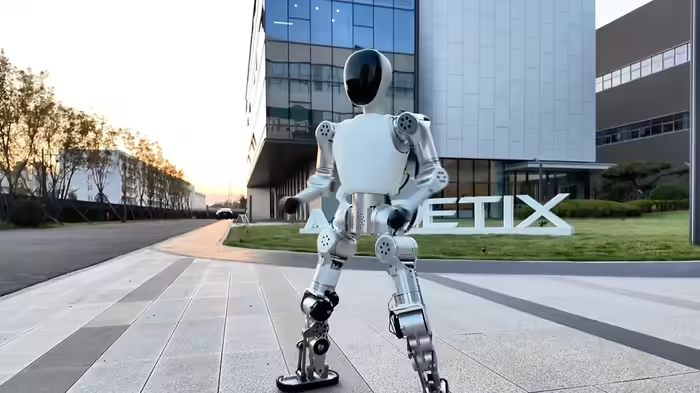
China has unveiled a humanoid robot named Bumi, priced at just 9,998 yuan (around $1,400 / ₹1,23,419)—comparable to the cost of an Apple iPhone. Unlike expensive U.S. humanoid robots, Bumi is affordable for schools, universities, and even regular households, making advanced robotics accessible to the masses.
Bumi can walk, run, dance, and respond to verbal commands. It can also be programmed using a drag-and-drop interface, making it user-friendly even for beginners. Its compact and lightweight design makes it suitable for educational purposes, while also serving as an interactive and entertaining companion for children.
Affordable Robotics for Education
Humanoid robots have long been used in classrooms and research labs, but high costs limited their accessibility. Bumi changes that scenario. Schools and universities can now introduce students to AI and robotics without spending a fortune. For children, the robot doubles as a fun and educational tool, helping them understand future technologies.
Sales and Collaborations
Bumi is set to hit the market in January 2026. Chinese company Songyan Power has partnered with Huichen Technology to supply 1,000 Bumi robots, marking a major step in promoting affordable humanoid robots globally.
U.S. Humanoid Robots Remain Expensive
By comparison, U.S. humanoid robots are priced significantly higher. Tesla’s Optimus could cost $20,000–$30,000 (₹27–30 lakh) at scale, while Digit by Agility Robotics is priced at around $250,000 (₹2.25 crore), primarily for industrial and warehouse use. Such prices make them inaccessible for general consumers.
China Focuses on Cost-Effective Solutions
China’s strategy prioritizes affordability over cutting-edge AI sophistication, making humanoid robots like Bumi ideal for education and research. In contrast, American companies emphasize advanced AI and high-end performance.
What Are Humanoid Robots?
Humanoid robots are designed to resemble humans in appearance and movement. They can walk, talk, and mimic human expressions, bridging the gap between interactive technology and real-world human interaction.
With Bumi, China has taken a major step in democratizing humanoid robotics, potentially reshaping the global robotics market and bringing AI learning to ordinary households.
Discover more from SD NEWS agency
Subscribe to get the latest posts sent to your email.