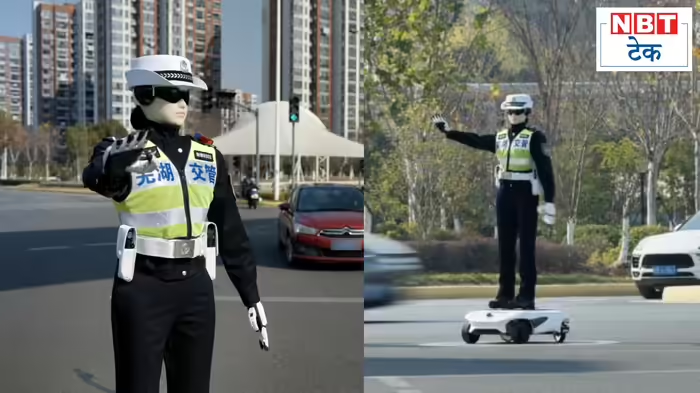
China is taking traffic management to the next level—robot police are now controlling intersections and issuing fines when necessary. Equipped with AI algorithms and high-definition cameras, these humanoid traffic officers can detect violations by cyclists and pedestrians, issue on-the-spot warnings, and, in some cases, send fines directly to offenders’ homes. Evading these “robo cops” is almost impossible.
A Glimpse into Wuhu City
To understand China’s technological advancement, one need only observe a busy intersection in Wuhu, Anhui Province. Here, cyclists are guided to use non-motorized lanes—not by human officers, but by a humanoid robot. Dressed in a police uniform, reflective jacket, and white cap, the robot bears the badge “Intelligent Police Unit R001.” From a distance, it looks entirely human, though its metallic sheen and futuristic design have made it a local celebrity.
What Makes China’s Robot Police Special?
The Intelligent Police Unit R001 is an AI-powered traffic policing robot connected to the city’s traffic signal system. This allows it to coordinate gestures and warnings with changing traffic lights. Equipped with high-definition cameras and an intelligent voice-broadcasting system, the robot can detect traffic violations, issue immediate alerts, and even monitor illegal parking. It operates 24/7 and can move independently from one location to another. Its capabilities also include real-time street monitoring, ensuring continuous public safety.
Robot Police in China on the Rise
Since last year, multiple Chinese cities have started deploying robotic police units. In June 2025, Chengdu in Sichuan Province introduced a team including quadruped robots, wheeled robots, and humanoid units. Similarly, in December, Hangzhou in Zhejiang Province deployed AI-powered traffic policing robots. According to a report by China’s State Council Development Research Center, the AI industry in China is projected to reach 400 billion yuan (~$57.1 billion) by 2030 and exceed 1 trillion yuan by 2035.
Looking Ahead
Zhang Guibing, General Manager of AiMOGA Robotics, emphasizes, “Products developed only in the lab are never truly tested. To earn public trust, these products must be deployed and used in the real world.” AiMOGA’s robotic systems are already operational in over 100 locations, performing tasks in security, public service, and hospitality. In 2025 alone, AiMOGA delivered around 300 humanoid robots and 1,000 quadruped robots, with operations now in 30+ countries. In the future, these robots are expected to assist in emergency services and provide real-time information for public safety.
Discover more from SD NEWS agency
Subscribe to get the latest posts sent to your email.