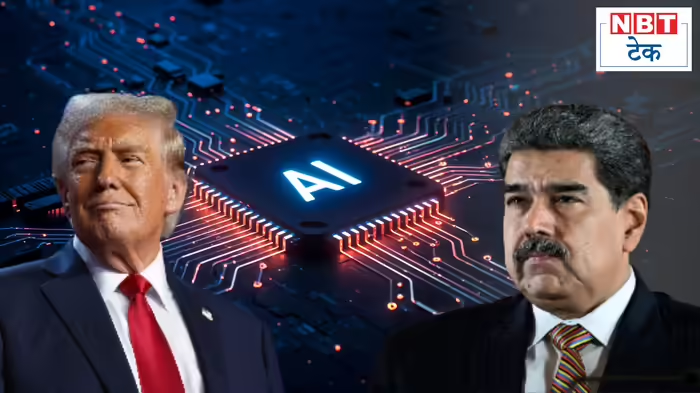
The rise of artificial intelligence (AI) is challenging people’s ability to distinguish between truth and falsehood, a concern highlighted by recent events surrounding the U.S. operation in Venezuela. Following the operation, numerous AI-generated images and videos began circulating on social media, some of which were highly realistic and misleading.
AI-Generated Content Sparks Confusion
After an incident where a U.S. Immigration and Customs Enforcement (ICE) officer shot a woman, fake photos and videos depicting the scene went viral. Some attempts even used AI to alter the officer’s face, demonstrating how convincingly AI can manipulate real events.
Media experts warn that AI-generated misinformation is eroding trust online, especially when fabricated content closely resembles actual footage or photographs.
Fake Photos of Maduro’s Arrest
U.S. President Donald Trump shared a photo on his verified social account showing Venezuelan leader Nicolás Maduro handcuffed and blindfolded on a naval ship. This triggered a wave of unverified photos and AI-generated videos purportedly showing Maduro’s arrest, which quickly spread across social media platforms. Some of these were so realistic that many users were misled into believing they were genuine.
Elon Musk Shares AI Video
Elon Musk, owner of X (formerly Twitter), also shared an AI-generated video allegedly showing Venezuelans thanking the U.S. for Maduro’s arrest. Such instances illustrate how even high-profile social media figures can inadvertently amplify misleading content.
Erosion of Trust in Digital Media
Jeff Hancock, founding director of the Stanford Social Media Lab, told NBC News that as AI technology advances, it rapidly undermines trust in online communication. Users may increasingly hesitate to believe what they see in digital spaces until they have verified proof.
Not the First Time Manipulation Occurred
Before AI, misinformation existed in various forms. During the 2016 U.S. elections, manipulated content circulated widely. Even after the invention of the printing press in the 1400s, large-scale dissemination of misleading content was common. Prior to AI, tools like Photoshop—and before that, analog image manipulation techniques—were used to alter visuals. However, AI now makes it extremely difficult to distinguish between real and fake, creating a new challenge for information verification.
As AI continues to advance, the line between reality and fabrication blurs, making digital literacy and careful verification more critical than ever.
Discover more from SD NEWS agency
Subscribe to get the latest posts sent to your email.